The Mariana Trench is the deepest known place in the world’s oceans. At its lowest point, a spot called Challenger Deep, the seafloor sits about 35,876 feet (10,935 meters) below the surface. If you dropped Mount Everest into it, the peak would still be more than a mile underwater.
For most of history, nobody knew what was down there. Some people assumed nothing could survive. That turned out to be wrong. The bottom is cold, dark and under enormous pressure, but it is home to microbes, giant single-celled organisms, shrimp-like crustaceans and fish that live deeper than almost anything else with a backbone. It also holds something nobody wanted to find: our trash.
Quick facts
| Location | Western Pacific, about 200 km (124 miles) east of the Mariana Islands |
| Length and width | About 2,550 km (1,580 miles) long and 69 km (43 miles) wide |
| Deepest point | Challenger Deep, about 10,935 m (35,876 ft) |
| Pressure at the bottom | Roughly 1,072 times sea-level air pressure |
| Water temperature | About 1 to 4 °C (34 to 39 °F) |
| First crewed dive | Trieste, January 23, 1960 |
How deep is the Mariana Trench?
The Mariana Trench is a long, crescent-shaped scar in the floor of the western Pacific. Most of it is already far deeper than the average ocean, which NOAA puts at about 12,080 feet. Challenger Deep, at the southern end of the trench several hundred kilometers southwest of Guam, is roughly three times deeper than that average.
The exact number has moved around over the years as instruments improved. Wikipedia’s summary of the measurements gives 10,935 meters with an uncertainty of about 6 meters, which matches NOAA’s figure of 35,876 feet. The deep is named after the British ship HMS Challenger, whose crew took the first sounding of the trench in 1875 and recorded about 8,184 meters. A later ship, Challenger II, used echo sounding in 1951 and got close to the modern figure.
The trench exists because of plate tectonics. The Pacific plate is sliding underneath the smaller Mariana plate, a process called subduction. Water released from the sinking crust feeds the volcanoes that built the Mariana Islands.
Most of the Mariana Trench is protected as part of the Mariana Trench Marine National Monument, created by the United States in 2009. Challenger Deep itself is not inside the monument, because it lies in the waters of the Federated States of Micronesia.
What it is like at the bottom
Sunlight disappears long before you get anywhere near the floor. At Challenger Deep it is completely dark, and the water hovers just above freezing, around 1 to 4 °C.
The real problem is pressure. At the bottom it reaches about 1,086 bar, which is roughly 1,072 times the air pressure you feel at sea level. Any vehicle that goes down has to be built to resist that weight of water pressing in from every side, which is why so few have made it.
The floor itself is mostly soft, pale sediment. When the first crew landed in 1960, their craft kicked up such a thick cloud of silt that they could barely see anything during their short stay.
Later visitors had better luck. When James Cameron reached the bottom alone in 2012, he spent about three hours there, collecting samples for several branches of marine science and recording photos and video. Vescovo’s dives in 2019 typically gave him three to four hours on the floor. That extra time is what turned Challenger Deep from a record to chase into a place scientists can actually study.
Who has been to Challenger Deep?
For decades, only two people had ever been to the bottom. That changed after 2019, when repeat dives became possible. According to Wikipedia’s count, there had been 22 crewed and seven uncrewed descents as of 2022.
| Year | Vehicle and crew | What happened |
|---|---|---|
| 1960 | Trieste: Don Walsh and Jacques Piccard | First crewed dive. Nearly five hours down, about 20 minutes on the bottom |
| 1995 | Kaikō (robot, Japan) | Uncrewed vehicle set a diving record of 10,911 m |
| 2009 | Nereus (robot) | Uncrewed hybrid vehicle reached the trench |
| 2012 | Deepsea Challenger: James Cameron | First solo dive. 2 hours 36 minutes down, about 3 hours on the bottom |
| 2019 | Limiting Factor: Victor Vescovo | Reached about 10,928 m and became the first person to dive to Challenger Deep more than once |
| 2022 | Crewed dive: Dawn Wright | First Black woman to explore the trench |
What lives at the bottom of the Mariana Trench
Life at these depths is small, slow and strange, but it is there. Researchers have found single-celled organisms called monothalamea at around 10.6 km down. Some of their relatives, the xenophyophores, grow into giant single cells more than 10 cm across, which is huge for something made of one cell.
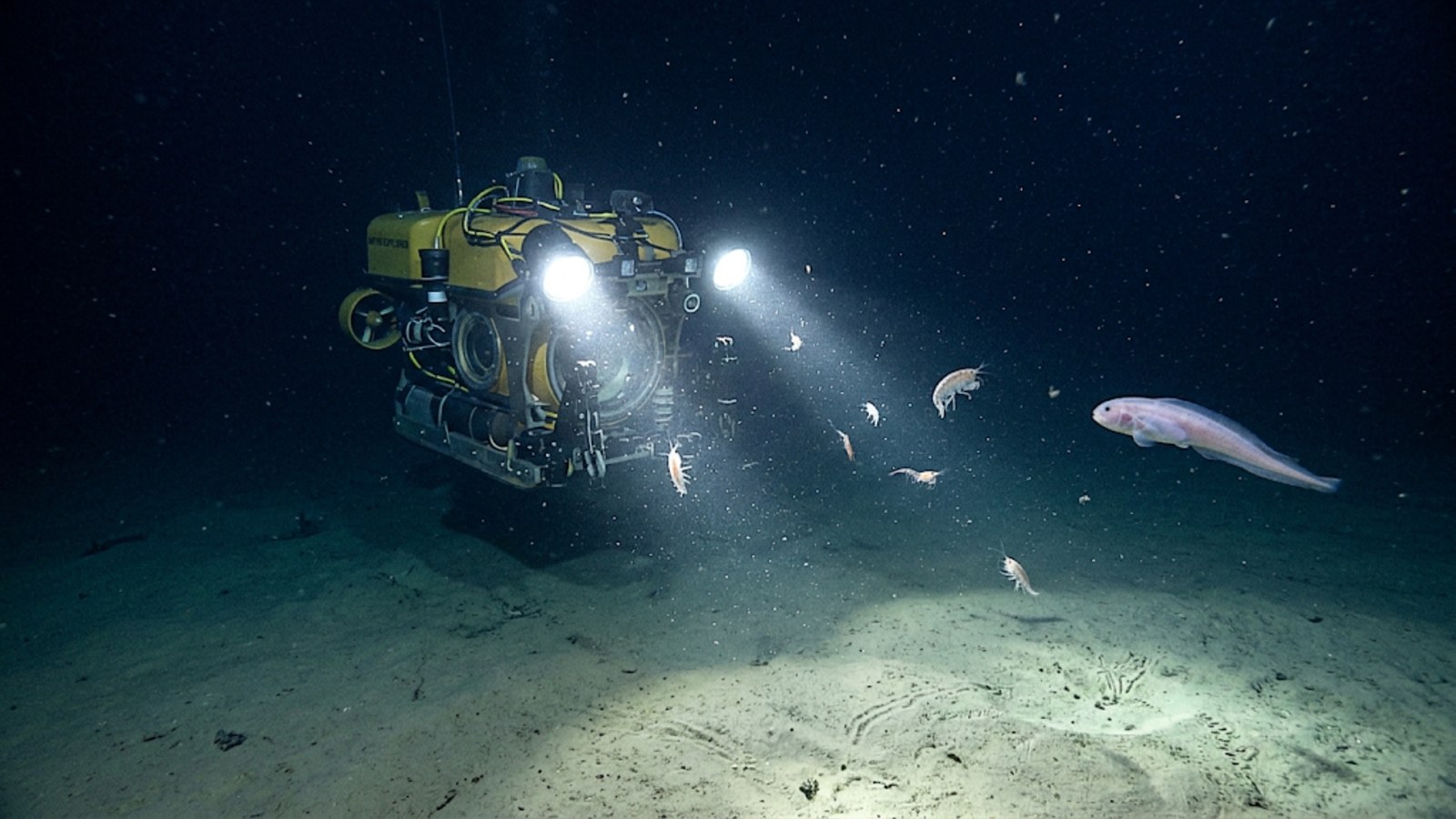
Amphipods are the animals people most often see in deep-trench footage. They are shrimp-like crustaceans that scavenge whatever food drifts down from above, and some of the trench species are so large they are called supergiants. Vescovo’s 2019 team said it believed it had collected four new species of amphipod.
Fish make it surprisingly deep too. The Mariana snailfish, a small, pale, almost jelly-like fish, was recorded at 8,145 meters in 2014, at the time a record for a fish caught on film. Vescovo’s team also reported a pink snailfish at about 8,000 meters and a spoon worm at around 7,000 meters.
- Microbes: bacteria and archaea living in the sediment and water
- Giant single cells: xenophyophores over 10 cm wide
- Amphipods: scavenging crustaceans, including supergiant species
- Snailfish: pale fish filmed more than 8 km down
Thousands of microbes nobody had seen before
One of the biggest recent discoveries came from Chinese researchers who published their results in the journal Cell in March 2025. Using a crewed submersible, they made 33 dives into the hadal zone, the band of ocean deeper than about 6 km, and collected sediment and seawater.
According to ScienceAlert’s report on the study, the team identified 7,564 microbial species, and nearly 90 percent were new to science. Some had small, efficient genomes built to resist stress. Others had larger genomes that let them do many different jobs. Communities in the deepest samples seemed to rely more on cooperation, including forming protective biofilms.
In other words, the trench floor is less like a dead desert and more like a quiet, specialized ecosystem that scientists have barely started to catalog.
Plastic and pollution, even here
The most uncomfortable find at the bottom of the Mariana Trench came in 2019. During his dives, Victor Vescovo reported seeing a plastic bag and candy wrappers on the seafloor at Challenger Deep. He called it very disappointing to see obvious human contamination at the deepest point in the ocean.
It was not a one-off. Studies have found raised levels of PCBs, a banned group of industrial chemicals, in trench animals, and microplastics in the stomachs of amphipods. Pollution from the surface sinks, and the trench acts as a kind of final collecting point.
Why the deepest ocean still matters
The Mariana Trench is not a monster lair or a hidden city, whatever some videos suggest. What it really holds is harder to film but more interesting: life that has adapted to extreme cold, darkness and pressure, plus a record of how far human pollution now travels.
Every new dive still brings back species and samples nobody has studied. With only a few dozen descents in more than 60 years, the bottom of the trench remains one of the least explored places on Earth.
Frequently asked questions
What is at the bottom of the Mariana Trench?
Soft sediment, near-freezing water and total darkness, plus life: microbes, giant single-celled xenophyophores, amphipods and, a little higher up, snailfish. Explorers have also found plastic litter there.
How deep is the Mariana Trench in miles?
At Challenger Deep it is about 35,876 feet deep, which is just under 7 miles (about 10.9 km).
Has anyone been to the bottom of the Mariana Trench?
Yes. Don Walsh and Jacques Piccard reached Challenger Deep in 1960, James Cameron went solo in 2012, and Victor Vescovo and others have made repeated dives since 2019.
Could Mount Everest fit in the Mariana Trench?
Yes. Challenger Deep is more than 2 km deeper than Everest is tall, so the summit would still be over a mile underwater.
Is there a fish at the bottom of the Mariana Trench?
Fish live deep in the trench, but not at its lowest point as far as records show. The Mariana snailfish was filmed at 8,145 meters in 2014, still well above Challenger Deep.
Keep reading
Like hidden stories, mysteries and new tech? We cover them every week on The Hidden Secrets YouTube channel.
Sources
- Wikipedia: Mariana Trench size, depth, pressure, formation, dive history, life and pollution
- NOAA Ocean Service: Challenger Deep depth and average ocean depth
- The Maritime Executive: 1960 Trieste dive details
- ScienceDaily: James Cameron’s 2012 solo dive
- Australian Geographic: Vescovo’s 2019 dives, plastic and new species
- ScienceAlert: 2025 Cell study of hadal microbes
Last updated October 2026. Featured image is AI-generated for illustration.