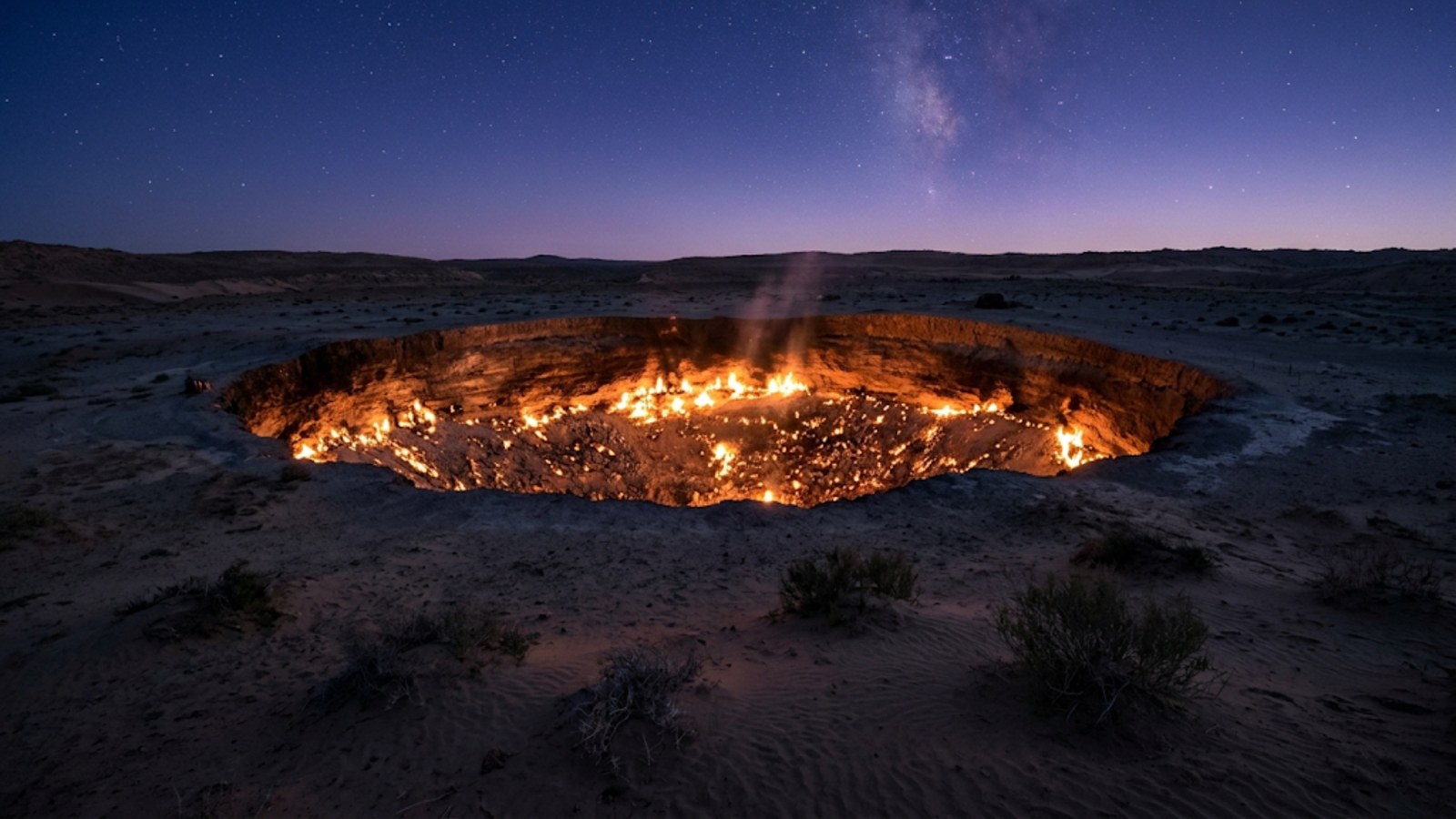
Turkmenistan is a country few people visit, yet almost everyone has seen pictures of one place there. The Door to Hell Turkmenistan is known for is exactly what it sounds like: a huge pit in the desert filled with fire. Officially called the Shining of Karakum, the Darvaza gas crater has been burning for decades, and for many travelers it is the main reason to make the trip.
That may be changing. Since 2025, Turkmen officials have said the fire has shrunk sharply, satellites show it fading, and engineers have a plan to cut off its gas supply. Here is how the crater formed, why its origin is still murky, and where things stand as of October 2026.
Quick facts
| Official name | Shining of Karakum (also called the Door to Hell or Gates of Hell) |
| Location | Near Darvaza, Karakum Desert, Ahal Province, about 260 km (160 miles) north of Ashgabat |
| Size | About 60 to 70 m (200 to 230 ft) across and roughly 20 to 30 m deep |
| Burning since | Usually given as 1971, though the official account says the crater formed in 1963 |
| Fire reduction | Nearly threefold, according to state gas company Turkmengaz in June 2025 |
| Status, October 2026 | Still burning at a much lower level; a new diversion well has been planned |
Where the Door to Hell in Turkmenistan is
The crater sits near the village of Darvaza in the middle of the Karakum Desert, in Turkmenistan’s Ahal Province. It is roughly 260 km (160 miles) north of the capital, Ashgabat, about a four-hour drive. Turkmen government sources put the distance at around 270 km.
It is about 60 to 70 meters wide. Depth estimates range from about 20 meters in the official Turkmen description to about 30 meters in other accounts. Until recently, hundreds of small gas fires lit the floor and walls, which is why it glows so dramatically at night. A second gas crater nearby is fenced off.
How the crater formed: the story nobody can quite confirm
The most widely told version goes like this. In 1971 Soviet engineers drilling in the area punctured a cavern full of natural gas. The ground collapsed, and to stop poisonous gas from spreading they set it alight, expecting it to burn out within days. It did not.
Other accounts disagree. Some local geologists say the collapse happened in the 1960s and the gas was only lit in the 1980s. The Turkmen oil and gas ministry’s own publication says an exploratory well on the Chaljulba gas structure hit a shallow gas-filled cavity in 1963, creating a sinkhole that was then set on fire to protect people and animals.
The honest answer is that the early history is unclear. Records from the Soviet period are missing, classified or hard to access, so the 1971 date is a convention rather than a confirmed fact.
Known: a gas drilling collapse created the crater, and the gas was deliberately lit. Disputed: the year it happened and when the fire was started.
The man who climbed into the fire
In 2013 explorer and storm chaser George Kourounis became the first person known to set foot at the bottom of the crater. The descent was sponsored by National Geographic and featured in its series Die Trying.
He wore an aluminized heat suit and a self-contained breathing apparatus, with a Kevlar harness and Technora ropes. His goal was scientific: collecting soil samples from the crater floor for the Extreme Microbiome Project. He has said he would like to return with more equipment to study the crater’s microbes properly.
He later described the scene as a “coliseum of fire,” a phrase that has followed the crater ever since.
Why Turkmenistan wants the fire out
The crater is spectacular, but it is also wasted gas and a source of pollution. As early as April 2010, then President Gurbanguly Berdimuhamedov recommended steps to limit the crater’s impact on developing other gas fields nearby.
In January 2022 he went further and ordered officials to find a way to extinguish it, citing harm to the environment, local health and the gas industry. A commission was set up to choose a method.
The cost of doing nothing is significant. Analysts quoted by Radio Free Europe/Radio Liberty estimated the site’s total greenhouse gas output is equal to the annual emissions of about 7 million vehicles, and that the lost gas is worth roughly $300 million. Data from the monitoring group Carbon Mapper, cited on Wikipedia, put average methane emissions at about 1,300 kg per hour between 2022 and 2025.
The flames are fading: what changed in 2025
The first big signal came in June 2025. At an energy conference, Irina Luryeva, a research head at state gas company Turkmengaz, said the fires had been reduced nearly threefold. She said several mothballed gas wells near the site had been reopened to divert gas away from the crater.
Satellite imagery backs this up. A collection of images from Colorado State University’s CIRA, covering February 2022 to May 2025, shows the flames at Darvaza decreasing as gas is directed away. An analysis by flare-monitoring company Capterio found the crater’s heat intensity had fallen by more than 75 percent over three years.
Visitors noticed too. Dylan Harris of Lupine Travel told RFE/RL he had seen a gradual decline for years, with flames significantly lower in the most recent season. By August 2025 the crater was reported to have only a few pockets of small fires left.
The plan to finish the job
Reducing the fire is not the same as stopping it. In late December 2025 Turkmengaz announced a plan to drill a new well to redirect gas from the crater’s underground source.
Scientists at the company’s Natural Gas Research Institute propose drilling an appraisal well in the Chaljulba field and drawing gas heavily from the most productive reservoir. That would lower the pressure feeding the crater, after which its surface could be sealed. Some of the diverted gas could be captured for use.
It is a tricky problem. The gas-bearing layers lie between about 200 and 950 meters underground, and gas escapes from many points within a 20-meter radius, so earlier attempts to find and plug the original well failed. Sealing one outlet can simply push gas out somewhere else.
- Sukru Merey, a gas engineering expert at Batman University, told RFE/RL that full elimination of leakage may not be possible even after drilling.
- He estimated that a secondary well would cost millions of dollars.
- Times of Central Asia reported that the outcome will remain uncertain until drilling starts and pressure changes can be measured.
Door to Hell Turkmenistan status in 2026: can you still visit?
Yes, as of October 2026 the crater has not been fully extinguished, and the latest reports describe a much smaller fire rather than none at all. Infrared images from 2026 show the fires still declining, and a July 2026 Boing Boing report described the crater as finally going out. We found no report confirming that the new diversion well has been completed.
Getting there is an adventure in itself. Foreigners need a visa to enter Turkmenistan, the road to the site is rough and unsigned, and visitors usually stay overnight in yurts set up nearby. The area was declared a natural reserve in 2013.
If the plan works, the most famous sight in Turkmenistan could become a dark, quiet hole in the sand. RFE/RL reported that tourism is expected to take a significant hit when that happens, so anyone who wants to see the glow may not have many years left.
Frequently asked questions
Is the Door to Hell still burning in 2026?
Yes, but at a much lower level. Turkmen officials said in 2025 the fire had been cut nearly threefold, and as of October 2026 it had not been fully extinguished.
How did the Door to Hell start?
A gas drilling operation caused the ground to collapse into a gas-filled cavity, and the gas was set alight to stop it spreading. The year is disputed, with 1971 the most common date and 1963 in official Turkmen accounts.
Has anyone gone inside the Darvaza crater?
Explorer George Kourounis descended to the bottom in 2013 in a heat suit to collect soil samples for the Extreme Microbiome Project.
Why is Turkmenistan putting out the Darvaza fire?
Officials cite harm to the environment, health and the gas industry. The crater wastes valuable gas and releases large amounts of greenhouse gases.
How far is the Door to Hell from Ashgabat?
About 260 to 270 km (roughly 160 miles) north of Ashgabat, around four hours by road.
Keep reading
Like hidden stories, mysteries and new tech? We cover them every week on The Hidden Secrets YouTube channel.
Sources
- Wikipedia: location, size, origin accounts, Kourounis descent, 2010 and 2022 orders, Capterio and Carbon Mapper data, tourism
- RFE/RL: Turkmengaz threefold reduction, reopened wells, new well plan, Merey and Harris comments, emissions estimates
- Times of Central Asia: Chaljulba well plan, gas layer depths and uncertainty
- Turkmenistan oil and gas portal: official 1963 origin account and diversion plan
- CIRA, Colorado State University: satellite imagery of reduced fires, 2022 to 2025
- Boing Boing: July 2026 report on the crater going out and Capterio’s heat analysis
Last updated October 2026. Featured image is AI-generated for illustration.