In early 1959 a group of nine experienced hikers set out on a winter trek in the northern Ural Mountains of the Soviet Union. Weeks later searchers found their tent slashed open from the inside and the hikers scattered across the snowy slope, all dead. What drove them out into the freezing night? The Dyatlov Pass incident has puzzled people for more than 60 years.
Quick facts
| Date | Night of 1 to 2 February 1959 |
| Location | Eastern slope of Kholat Syakhl, northern Ural Mountains, Russia |
| Group | Nine hikers, mostly students and graduates of the Ural Polytechnic Institute |
| Leader | Igor Dyatlov, aged 23 |
| Official 2020 conclusion | An avalanche, followed by deaths from cold |
What happened
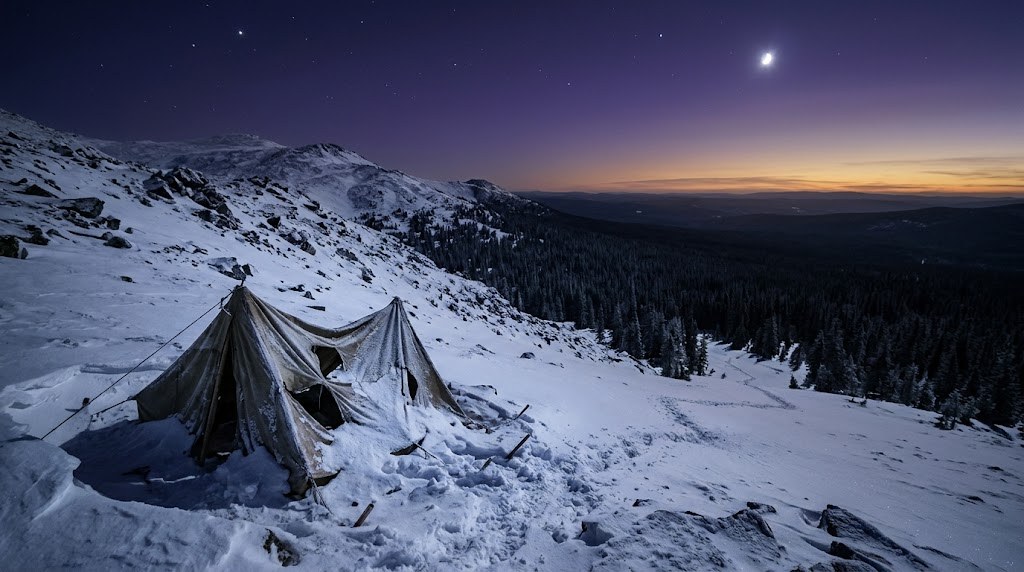
The group was highly experienced and planned a demanding ski trek. On 1 February they pitched their tent on an open slope. When they failed to return, searchers set out. On 26 February they found the tent partly covered in snow and cut open from the inside. Footprints led down the slope towards the forest, made by people wearing socks or only one shoe.
The first bodies were found near the edge of the forest beside the remains of a small fire. Others lay between the fire and the tent, as if trying to return. The last four were not found until May, in a ravine buried under deep snow. Most had died of hypothermia, but the four in the ravine had serious injuries such as broken ribs and skull fractures, without many external wounds.
The original investigation
Soviet investigators closed the case in 1959, concluding that the hikers died because of a "compelling natural force". The files were kept secret for decades, which only encouraged speculation.
The theories
- Avalanche. A slab of snow hit or threatened the tent, forcing the group to cut their way out and flee.
- Military testing. Some point to reports of strange lights in the sky and suggest the hikers stumbled into a weapons test.
- Infrasound. Wind around the mountain might have created low frequency sound causing panic.
- Attack. Early theories blamed local Mansi people, escaped prisoners or even a yeti, but there was no evidence of other people at the site.
What science says now
In 2019 Russian prosecutors reopened the case and in 2020 concluded that an avalanche was the cause. In 2021 two scientists, Johan Gaume of the Swiss Federal Institute of Technology in Lausanne and Alexander Puzrin of ETH Zurich, published a study showing how a small, delayed slab avalanche could have formed after the hikers cut into the slope to pitch their tent. Using computer models, partly inspired by car crash testing, they showed it could cause the kinds of injuries found, even if little snow was left on the tent by the time searchers arrived.
In that scenario, the frightened group fled to the shelter of the forest, expecting to return. In darkness and temperatures far below freezing, they could not.
Frequently asked questions
Is the Dyatlov Pass incident solved?
The official Russian conclusion and recent research point to an avalanche. Some relatives and researchers still dispute it.
Why did the hikers leave their tent?
Most likely to escape snow sliding onto or threatening the tent.
Where is Dyatlov Pass?
In the northern Ural Mountains of Russia. The pass is now named after the group's leader.
Keep reading
Sources
- Gaume and Puzrin, "Mechanisms of slab avalanche release and impact in the Dyatlov Pass incident in 1959", Communications Earth and Environment, 2021
- Prosecutor General's Office of the Russian Federation, 2020 review