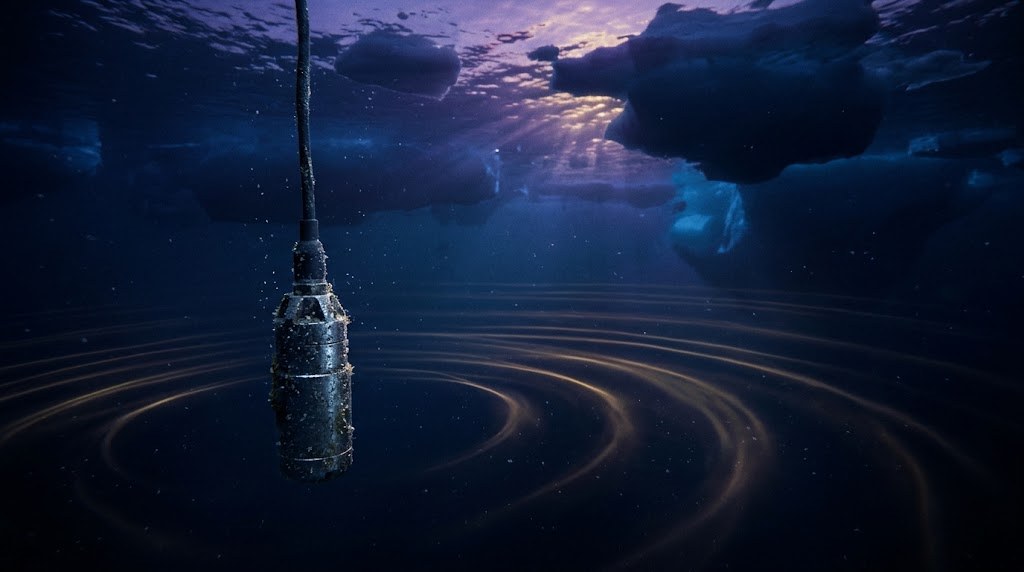
In the summer of 1997, underwater microphones operated by the US National Oceanic and Atmospheric Administration picked up an extremely loud, low sound coming from the remote South Pacific. It rose quickly in pitch and was heard by sensors thousands of kilometres apart. Scientists nicknamed it the Bloop, and the internet quickly decided it must be a giant sea monster.
Quick facts
| Recorded | 1997 |
| Recorded by | NOAA hydrophone arrays in the Pacific |
| Approximate source | Remote South Pacific, west of the southern tip of South America |
| Detection range | Heard by sensors around 5,000 km apart |
| Explanation | An icequake, ice cracking off Antarctica |
How the ocean was listening
During the Cold War, the US Navy laid networks of hydrophones on the seabed to track submarines. Sound travels very far through a layer of the ocean called the SOFAR channel, where temperature and pressure trap sound waves and let them travel across whole ocean basins. After the Cold War, scientists used these and newer hydrophones to listen for earthquakes, volcanoes and whales.
What the Bloop sounded like
The Bloop was ultra low frequency, mostly below the range of human hearing. To make it audible, NOAA sped the recording up about 16 times. The result is a rising whoosh lasting about a minute. What made it stand out was its sheer power and range.
Why people thought it was a monster
Early on, scientists noted that the sound's shape looked somewhat like sounds made by living animals. Combined with its enormous volume, that sparked the idea that it came from a creature far larger than a blue whale. The fact that its rough location was not far from the fictional sunken city of R'lyeh in H. P. Lovecraft's Cthulhu stories only added fuel. Documentaries and web forums ran with the giant monster idea for years.
What it really was
NOAA kept recording the region, and the answer came from Antarctica. As glaciers and ice shelves crack and large icebergs break away, the ice produces powerful sounds known as icequakes. Researchers recorded many of these and found they matched the Bloop closely. By 2005 NOAA concluded that the Bloop was almost certainly a large icequake, with the most likely source somewhere between the Bransfield Strait and Cape Adare in Antarctica.
Other strange ocean sounds
The Bloop was not alone. NOAA's catalogue also includes sounds nicknamed Julia, Upsweep, Slow Down and Train. Most have been linked to ice or volcanic activity, while Upsweep, a rising sound heard seasonally since 1991, is still not fully explained, though volcanic activity is the leading suspect.
Frequently asked questions
Was the Bloop a sea monster?
No. Scientists concluded it was the sound of ice breaking off Antarctica.
Can you hear the Bloop?
Yes, NOAA released a sped up version so humans can hear it.
Where did the Bloop come from?
The remote South Pacific, near the Antarctic coast, based on later analysis.
Keep reading
Sources
- NOAA Pacific Marine Environmental Laboratory, Acoustics Program
- NOAA Ocean Explorer, ocean sounds archive