The Hope Diamond curse is one of the best-known legends in the world. A sacred stone stolen from a statue in India, a merchant torn apart by wild dogs, a doomed French queen, a ruined American heiress. It makes a gripping story.
Most of it does not hold up. The diamond is real, its history is genuinely dramatic, and some of its owners did suffer. But historians who have traced the stone believe much of the curse was invented or embellished, partly to help sell it. Here is how the legend was built.
Quick facts
| Weight today | 45.52 carats |
| Color | Deep blue, caused by traces of boron |
| Origin | India, mined in the 1600s |
| Named after | Henry Philip Hope, who acquired it in 1839 |
| Donated by | Jeweler Harry Winston, 1958 |
| Where it is now | Smithsonian National Museum of Natural History, Washington, D.C. |
| Estimated value | Around $250 million (not for sale) |
From India to the French crown
The stone that became the Hope Diamond was mined in India in the 1600s and weighed about 112 carats as a rough gem. It was long thought to come from the Kollur mine, though newer evidence suggests the Wajrakarur area in Andhra Pradesh.
French gem merchant Jean-Baptiste Tavernier acquired it and sold it to King Louis XIV. The king had it recut into a smaller, brilliant stone known as the French Blue, part of the crown jewels.
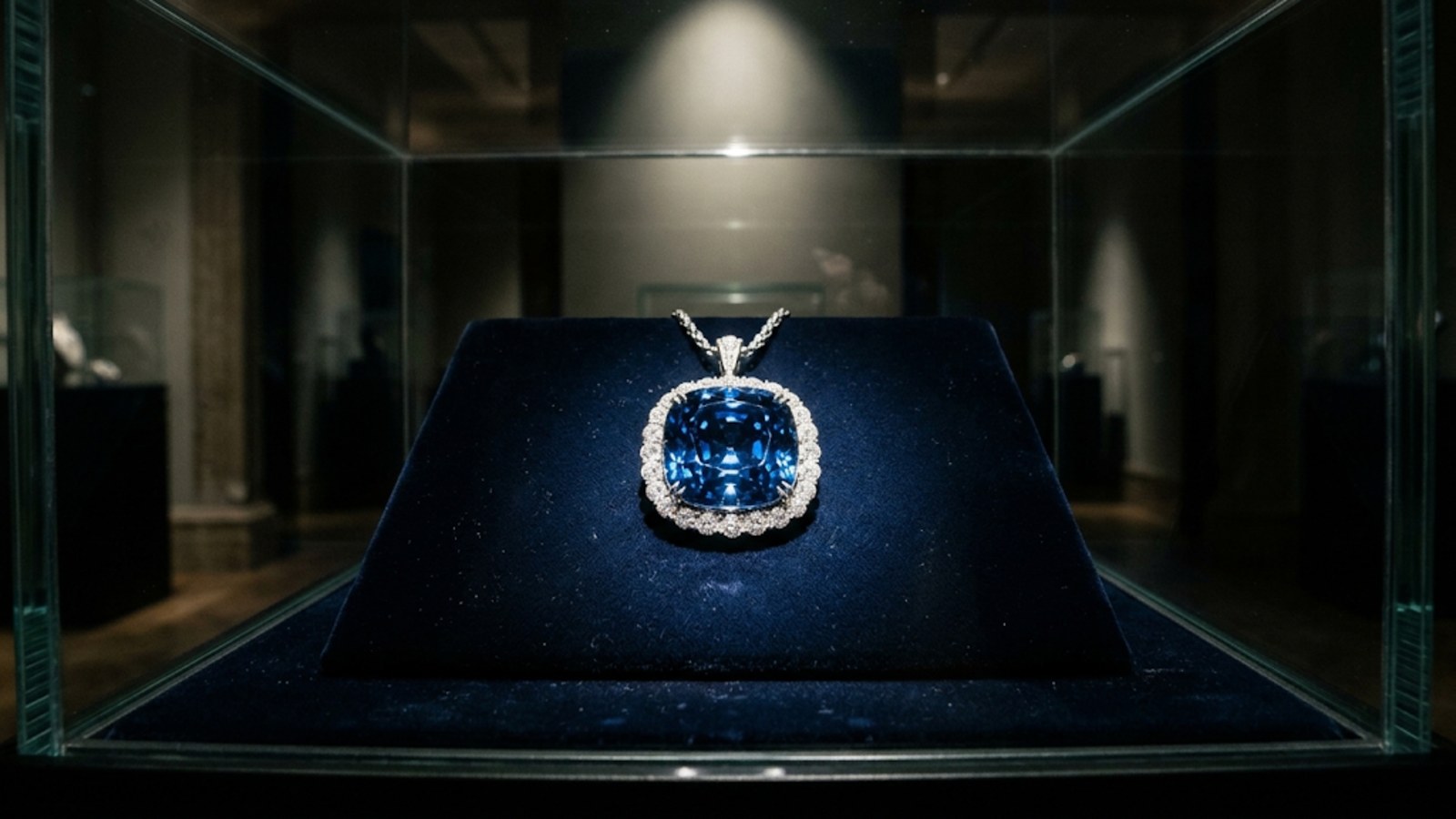
During the French Revolution, Louis XVI and Marie Antoinette were executed and the royal jewels were stolen. The French Blue vanished. A smaller blue diamond of 45.52 carats later emerged, and it is widely accepted to be the French Blue, recut so it could not be identified.
Where the Hope Diamond curse story begins
The most repeated version says Tavernier did not buy the stone at all. He supposedly pried it from the eye of a Hindu idol, and the temple’s guardians cursed anyone who owned it. Tavernier, the story adds, was later killed by dogs or wolves.
There is no evidence for any of this. Tavernier sold the diamond to the French king, retired and, by most accounts, died peacefully in old age. Historians also point out that if the gem had been one of a statue’s eyes, a matching second diamond should exist, and none has ever been found. Smithsonian folklorist Richard Kurin, who wrote a book-length history of the stone in 2006, disputes the idol story directly.
The Hope family and a showgirl
In 1839, financier and gem collector Henry Philip Hope acquired the diamond, and it took his family’s name. It later passed to Lord Francis Hope, who inherited it at 21. He lived far beyond his means, eventually had to sell the stone and went bankrupt.
His wife, the showgirl May Yohé, left him and later died in poverty. Her story was folded into the curse, but a spendthrift aristocrat and a failed marriage do not need a supernatural explanation.
Pierre Cartier and the sales pitch
By the early 1900s the diamond had moved through dealers, and stories of bad luck were already attached to it. One diamond dealer, Simon Frankel, reportedly called it the hoodoo diamond. Then it reached Pierre Cartier, of the famous Paris jewelry house.
Cartier wanted to sell it to Evalyn Walsh McLean, a wealthy American heiress who enjoyed the idea of owning something with a dark past. Historians suspect Cartier played up the curse rumors to make the stone more tempting, and he had it reset to suit her taste. McLean and her husband bought it in 1912.
Some accounts go further and suggest the McLeans themselves leaned into the curse talk to add glamour and value to their purchase. Either way, the legend was good for business.
Many of the ‘victims’ on popular curse lists, such as a Dutch jeweler murdered by his son or a Greek merchant who drove off a cliff, come with no dates, no records and no proof they ever owned the stone.
Evalyn Walsh McLean’s real tragedies
McLean is the strongest case curse believers have. Her young son was killed in a car accident. Her daughter also died, years later. Her husband left her for another woman and ended up confined to a psychiatric hospital, and she was forced to sell the family newspaper, The Washington Post. The Smithsonian has described her as “the poster child for the Hope diamond’s legendary curse.”
Her bad luck extended to con men too. During the Lindbergh kidnapping case, a swindler named Gaston Means took $100,000 from her by claiming he could get the baby back, when the child was already dead. Curse believers add this to the list, though it says more about how visible and wealthy she was than about any gem.
These losses were real and terrible. But they are also the kind of misfortunes that strike families with or without famous jewelry. Linking them to the diamond is a story we tell afterward, not something the evidence shows.
Harry Winston and the trip to the Smithsonian
After McLean died, New York jeweler Harry Winston bought the diamond from her estate along with her other jewels. In 1958 he donated it to the Smithsonian, and, famously, he sent it there through the U.S. mail.
Curse fans point to mail carrier James Todd, who delivered the package. Within a short time he was struck by a truck, though not fatally, his wife and his dog died, and his house caught fire. It sounds dramatic, but Winston himself suffered nothing unusual, and neither has the museum. Its attendance grew, and the Smithsonian has joked that the stone appears to have stayed curse-free in its care.
That is the core problem with the legend. The people whose misfortunes are listed are remembered because they suffered, while the owners and handlers who lived ordinary lives are quietly left out.
What science says about the stone
The real wonders of the Hope Diamond are physical. Its blue color comes from trace amounts of boron in the crystal. Under ultraviolet light it glows a vivid red and keeps glowing for a short time after the light is switched off.
Researchers from the Smithsonian and the U.S. Naval Research Laboratory, led by gem collection curator Jeffrey Post, measured this glow in dozens of blue diamonds and published the results in the journal Geology. Nearly all the natural blue diamonds showed a red component, while the fake blue diamonds they tested did not, which suggests the test could help spot imitations.
Today the Hope sits in a setting surrounded by 16 white diamonds, hanging from a chain of 45 more, on display at the National Museum of Natural History in Washington, D.C.
Frequently asked questions
Is the Hope Diamond really cursed?
There is no evidence of a curse. Historians believe many curse stories were invented or exaggerated, likely to boost the stone’s mystique and sale price.
Who started the Hope Diamond curse?
The legend grew in the early 1900s through dealers and press stories. Historians suspect Pierre Cartier embellished it to sell the gem to Evalyn Walsh McLean.
How much is the Hope Diamond worth?
It is not for sale, but estimates put its value at around $250 million.
Where is the Hope Diamond now?
It is on display at the Smithsonian’s National Museum of Natural History in Washington, D.C., which received it from Harry Winston in 1958.
Why does the Hope Diamond glow red?
Under ultraviolet light the stone gives off a red phosphorescence that lingers briefly after the light is turned off. Researchers think its particular mix of boron and nitrogen causes the glow.
Keep reading
Like hidden stories, mysteries and new tech? We cover them every week on The Hidden Secrets YouTube channel.
Sources
- Live Science: curse origins, Tavernier, Cartier, McLean, Hope family, Winston, James Todd, value
- Live Science: 45.52 carats, boron, mine origin, setting, Smithsonian
- Smithsonian Institution Archives: Richard Kurin’s 2006 history of the gem
- Smithsonian Magazine: red phosphorescence study, 112-carat rough
- Today I Found Out: Simon Frankel’s ‘hoodoo diamond’, Cartier and McLean, curse talk
- Mental Floss: the popular list of curse ‘victims’
Last updated October 2026. Featured image is AI-generated for illustration.