
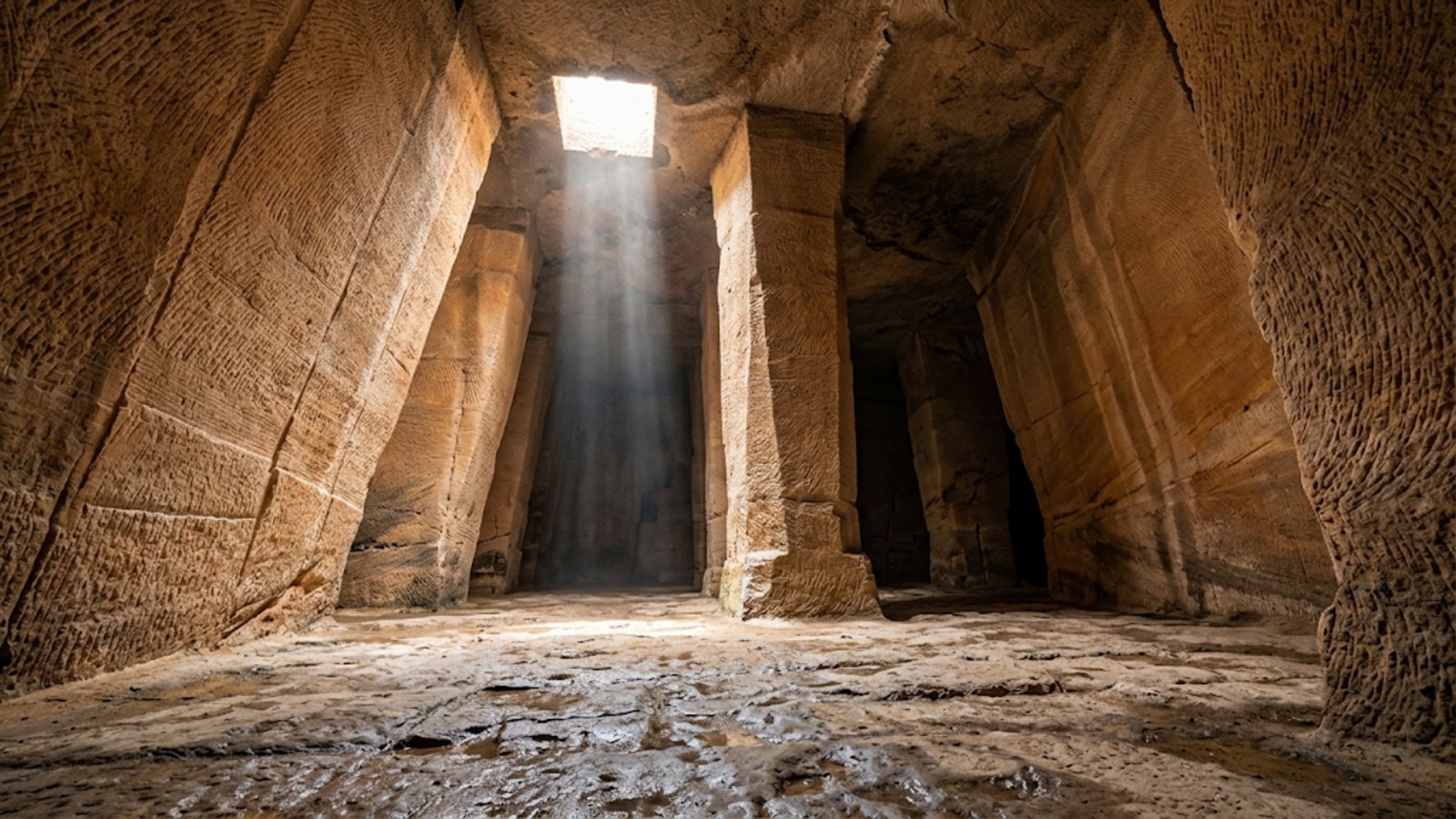
The Longyou Caves are a group of enormous man-made caverns cut into a hillside in Zhejiang Province, eastern China. Some have floors bigger than a basketball court and ceilings several stories high, and every wall is covered in tidy rows of chisel marks.
They are at least 2,000 years old, yet no record from the time mentions them. Nobody knows for sure who dug them, how long it took or what they were for. Here is what researchers have established, the main theories, and what is still an open question.
Quick facts
| Location | Fenghuang Hill, near Shiyan Beicun village, Longyou County, Zhejiang, China |
| Found | June 1992, by local farmers draining ponds |
| Number of caverns | 24 known |
| Rock | Siltstone of the Upper Cretaceous Quxian Formation |
| Estimated age | More than 2,000 years |
| Total area | Over 30,000 square meters |
| Written record | No contemporary account; a 17th-century poem is the earliest mention |
How the Longyou Caves Were Found
In June 1992, four farmers near Shiyan Beicun village decided to pump the water out of some small ponds. The ponds kept going. Once drained, they turned out to be the tops of large artificial caverns that had been flooded for centuries.
Further searching found more. There are now 24 known caverns in the group, five large ones and 19 smaller ones, spread across Fenghuang Hill beside the Qu River. The discovery drew specialists from China, Japan, Poland, Singapore and the United States.
What the Caverns Look Like
The scale is the first surprise. The average floor area is more than 1,000 square meters, and the whole complex covers over 30,000 square meters. Reported ceiling heights vary by source, with figures of 20 to 30 meters for the biggest rooms. Some caverns are held up by massive stone pillars left in place as the rock was cut away.
The second surprise is the finish. Ceilings, walls and pillars all carry the same pattern: parallel bands about 60 centimeters wide, filled with parallel chisel strokes set at roughly 60 degrees. It looks deliberate, like a house style.
Each large cavern has a single entrance linked to a vertical shaft with carved steps. Floors have drainage troughs and channels to handle rainwater. The walls slope inward, which reduces stress on the ceilings. The caves sit close together, yet none of them connect to each other.
Clues Hidden in the Design
Even without records, the caverns say a lot about their makers. The large caverns are aligned to face south to southwest, which Heritage Daily notes would let in as much sunlight as possible. The inclined walls are not just decoration either: they spread the load and take stress off the ceilings.
Water was clearly planned for. Rain and runoff enter through the shaft, then run into floor troughs, channels and a water trap. My Modern Met also describes carvings wrapping around the sandstone columns. Put together, this does not look like rough mining. It looks like a project with a plan, a budget of labor and people who knew the rock well.
What Still Puzzles Researchers
- No document from the period mentions the caverns or the workforce behind them.
- Every cavern shares the same chisel pattern, yet none connects to another.
- Roughly one million cubic meters of rock were removed, and where it went is unknown.
- No purpose has been confirmed, despite more than three decades of study since 1992.
How Old Are They?
The best dating clue is pottery. Glazed clay pots found in the silt on the cavern floors date to the Western Han dynasty, between 206 BC and AD 23. Some reports narrow artifacts to the reign of Emperor Xuan of Han, around 91 to 48 BC.
That gives a minimum age, not an exact one. The pots show the caves existed by then, but they could be older. A 2009 engineering study in Tunnelling and Underground Space Technology simply describes them as more than 2,000 years old.
The only written mention found so far is a 17th-century poem by Yu Xun, written well over a thousand years after the caverns were cut.
How Were They Built?
The tool marks suggest the work was done by hand. Researchers think the caverns were carved from the top down, one layer at a time, with short chisels of different sizes. Heritage Daily reports that several short chisels were found in one of the larger caves.
The amount of stone removed is huge. One estimate puts it at about one million cubic meters. No surviving record says where all that rock went, or how the builders kept the layout so consistent from cave to cave.
The rock helps. A 2009 study by L.H. Li and colleagues, archived by the University of Hong Kong, identified it as pelitic siltstone, a medium-to-hard rock near the surface. Soft enough to carve with hand tools, firm enough to stand for two millennia. Popular articles often call it sandstone, but the engineering study is more specific.
Theories About Why the Longyou Caves Exist
Because nothing was written down, every purpose is a theory. These are the ideas researchers and writers have put forward:
- Quarries: the stone was the point, and the caves were what was left.
- Tombs or a mausoleum for an important ruler or family.
- Underground storage for grain or other goods.
- Military camps hidden from view.
- Reservoirs for water.
- Religious sites, such as Taoist dwellings or places for offerings to gods and ancestors.
- A palace or other elite complex.
Which Explanation Holds Up Best?
None has been proven. As Heritage Daily puts it, the evidence cannot yet support or rule out any of them. The quarry idea explains the missing rock but not the careful decorative chisel pattern. The storage, military and tomb ideas fit the hidden, carefully built spaces, but nothing found so far confirms any of them.
A useful comparison is the Huashan Grottoes, about 200 kilometers to the northwest on the Xin’an River. They look somewhat similar but are thought to be much younger, from the late Ming dynasty. They show that large carved caverns were part of the region’s history, without solving who made the Longyou set.
If you want to see the caverns in person, you can. The caves have been conserved and excavated since 1992, and the most elaborately carved cavern is open to visitors. The ceilings, walls and pillars of the intact caves show little sign of damage, though some other caverns in the area have failed, which is why engineers continue to study the site and how to protect it.
Frequently asked questions
Who built the Longyou Caves?
Nobody knows. No records from the time they were made describe them, and no inscription naming the builders has been reported.
How old are the Longyou Caves?
At least 2,000 years. Pottery found in floor silt dates to the Western Han dynasty, between 206 BC and AD 23.
How many Longyou Caves are there?
Twenty-four caverns are known: five large ones found first when farmers drained ponds in 1992, and 19 more found nearby.
Are the Longyou Caves connected?
No. Even though they sit close together and share the same design, none of the caverns has a passage linking it to another.
Were the Longyou Caves made by aliens?
There is no evidence for that. The chisel marks, the tool finds and the dating all point to human workers using hand tools.
Keep reading
Like hidden stories, mysteries and new tech? We cover them every week on The Hidden Secrets YouTube channel.
Sources
- Wikipedia: location, 1992 discovery, 24 caverns, dimensions, chisel pattern, pottery dating, Yu Xun poem, Huashan comparison
- Heritage Daily: cavern design, drainage, construction method, chisels, proposed purposes
- My Modern Met: rock volume estimate, Emperor Xuan dating, visitor access, condition
- University of Hong Kong: Li et al. 2009 engineering geology study of the Longyou caverns
Last updated October 2026. Featured image is AI-generated for illustration.