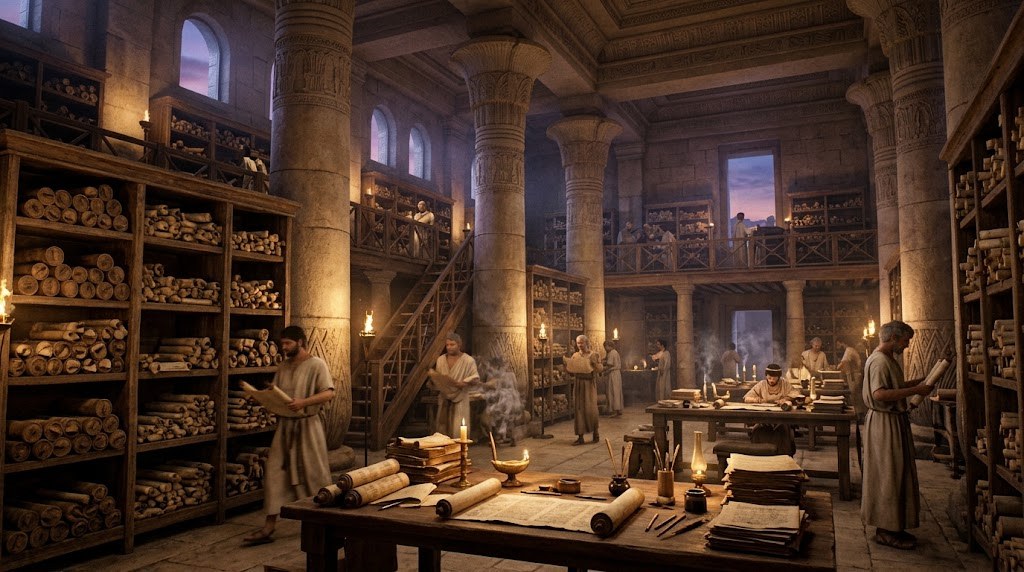
The Library of Alexandria was the most famous library of the ancient world, a place that tried to collect every book ever written. Its loss is often described as one of the great tragedies of history, usually pictured as a single catastrophic fire. The truth is less dramatic but more revealing: the library faded over centuries.
Quick facts
| Location | Alexandria, Egypt |
| Founded | Early 3rd century BC, under the Ptolemy dynasty |
| Part of | The Mouseion, a research institute |
| Collection size | Estimates range from about 40,000 to 400,000 scrolls |
| Famous head librarian | Eratosthenes, who estimated the size of the Earth |
| Modern successor | Bibliotheca Alexandrina, opened 2002 |
A library to hold all knowledge
After Alexander the Great's death, his general Ptolemy took control of Egypt. Ptolemy I and his son Ptolemy II built Alexandria into a centre of Greek learning. The library was part of the Mouseion, a kind of research institute where scholars lived, studied and were paid by the king.
The Ptolemies were famously aggressive collectors. Ancient writers say ships arriving in Alexandria had their books seized and copied, with the owners sometimes receiving the copy rather than the original. Scrolls were bought across the Mediterranean, and scholars worked to edit and catalogue them. The poet Callimachus compiled the Pinakes, a vast catalogue often called the first library catalogue.
The scholars
Some of the greatest minds of the ancient world worked in Alexandria. Eratosthenes measured the circumference of the Earth with impressive accuracy. Astronomers, mathematicians, doctors and grammarians edited the texts of Homer, studied anatomy and developed early science. The library was as much a university as a book collection.
How it really declined
There was no single day when the library died. Instead, several blows came over hundreds of years:
- 145 BC: Ptolemy VIII expelled many scholars from Alexandria during political struggles, a blow to its intellectual life.
- 48 BC: During Julius Caesar's war in Alexandria, a fire spread from the harbour and burned part of the city. Ancient sources disagree on how much of the library was lost, and scholars continued working there afterwards.
- 270s AD: Fighting under the Roman emperor Aurelian devastated the palace quarter where the library stood.
- 391 AD: The Serapeum, a temple that housed a daughter library, was destroyed during conflicts between Christians and pagans.
A story that the library was burned on the orders of the Caliph Umar in 642 AD appears only centuries later and most historians treat it as a legend. By then there was probably little left.
What was lost
We will never know exactly. Many ancient works survive only as titles or quotations, and some of them were surely kept in Alexandria. Yet many texts were copied and kept in other libraries too. The bigger loss may have been the community of scholars and the funding that supported them. Without money and political stability, scrolls decayed and were not recopied.
Frequently asked questions
Who destroyed the Library of Alexandria?
No one person. It declined over centuries through war, fires, political purges and lack of funding.
How many books were in the Library of Alexandria?
Ancient estimates vary widely, from around 40,000 to 400,000 scrolls.
Does the Library of Alexandria exist today?
The original does not. The modern Bibliotheca Alexandrina opened near the old site in 2002.
Keep reading
Sources
- Roger S. Bagnall, "Alexandria: Library of Dreams", Proceedings of the American Philosophical Society, 2002
- Plutarch, Life of Caesar
- Bibliotheca Alexandrina, history of the ancient library