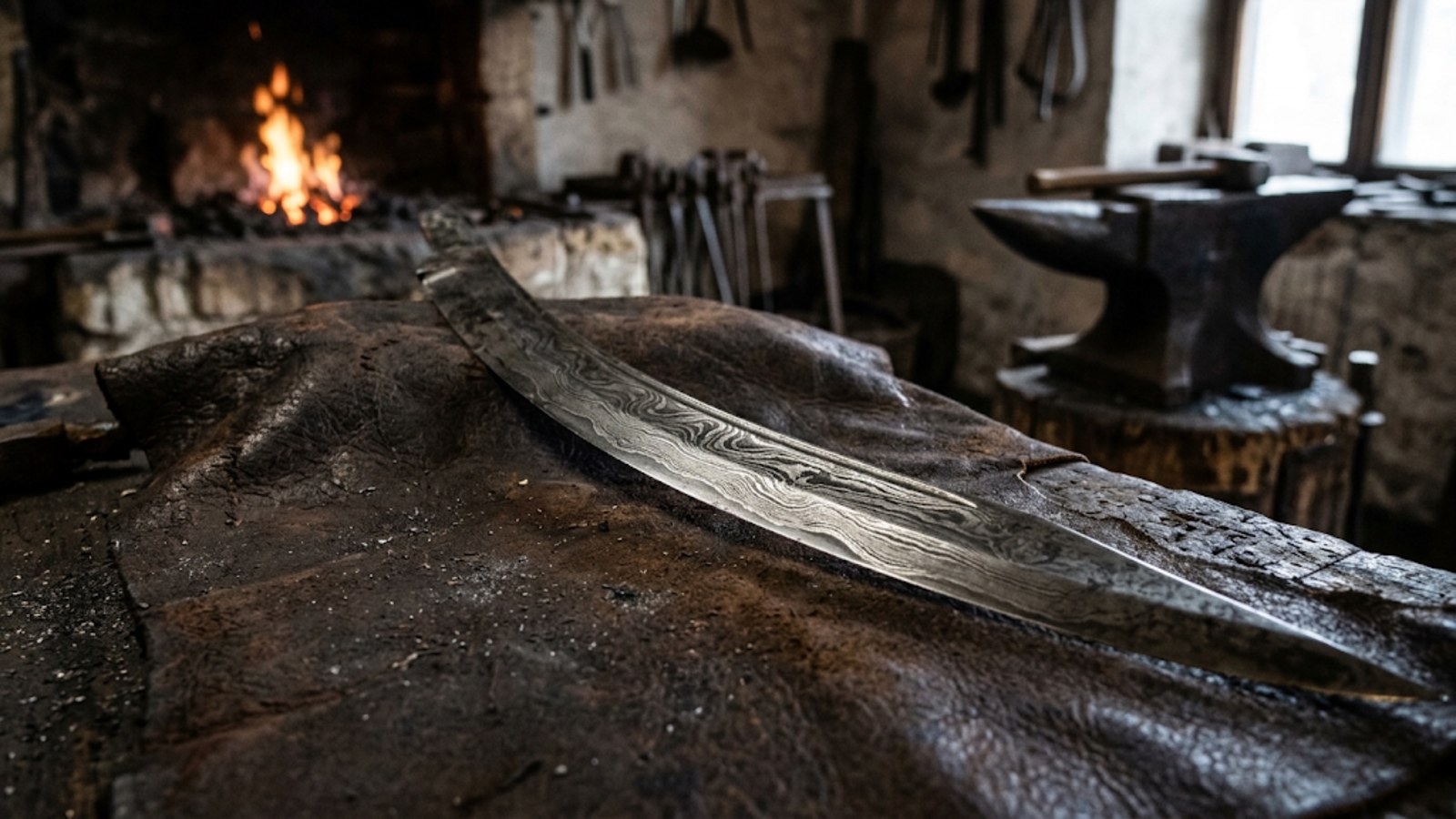
Damascus steel is the name given to a type of blade made in the Middle East for centuries, famous for a flowing, wavy pattern on its surface and a reputation for holding a keen edge. Crusader-era Europeans treated these swords as almost magical.
By the 1800s, nobody could make them anymore. The recipe had not been written down, and the know-how faded with the smiths who had it. Here is what Damascus steel actually was, why the technique was lost, what modern science found inside old blades, and how two Americans managed to bring the pattern back.
Quick facts
| What it was | Blades forged from wootz, a high-carbon crucible steel |
| Raw material from | India and Sri Lanka, traded across the Islamic world |
| Main era | Roughly 900 AD to about 1750 |
| Carbon content | About 1.5 percent |
| Why the pattern forms | Bands of iron carbide (cementite) lined up by trace impurities |
| Rediscovered by | John Verhoeven and Alfred Pendray, 1990s |
| Not the same as | Modern pattern-welded “Damascus” knives |
What Damascus Steel Was
The swords were finished by smiths in and around Damascus and across the Middle East, but the steel itself usually started much farther east. It was made from wootz, a crucible steel produced in places such as Sri Lanka and Telangana in India, then traded across the Islamic world. Crucible steelmaking there may date back to around 300 BC.
Wootz was made by sealing iron in clay crucibles with charcoal and plant material, then heating it until it melted and soaked up carbon. The result was a small ingot, or cake, of very high-carbon steel. Smiths then forged these cakes into blades through repeated heating, hammering and slow cooling, a process some accounts say could take a week for one blade.
Etched, the finished steel showed swirling light and dark bands. One theory links the name to the Arabic word damas, meaning water, because the pattern looks like rippling water. Others tie it to the city. Medieval writers such as Al-Kindi described swords made in Damascus as Damascene.
Why the Blades Had a Legendary Reputation
Stories said a Damascus blade could slice a silk scarf as it fell, or cut through ordinary swords without dulling. Those are legends, not tests. But the steel really was unusual for its time.
Wootz contains about 1.5 percent carbon, far more than most iron of the period. Extra carbon usually makes steel brittle. In Damascus blades, the carbon formed thin layers of hard iron carbide, called cementite, inside a tougher matrix. That gave a hard cutting edge without the whole blade snapping. Metallurgist John Verhoeven has said the idea that it beats modern steel is wrong, but wootz was better than most alternatives before the 1800s.
How the Damascus Steel Technique Was Lost
The last high-quality patterned blades date to about 1750, and the last low-quality ones to the early 1800s. Why it stopped is still debated, but the leading explanations are practical rather than mysterious.
- The ore changed. Verhoeven and Pendray found that tiny traces of elements such as vanadium were needed for the pattern. If smiths ran out of, or lost access to, the right Indian ores, the pattern would fail without anyone knowing why.
- The supply was cut. In India, the British East India Company reportedly ended wootz production in 1858, and forest laws in 1862 limited access to trees for charcoal.
- Nothing was written down. The method lived in the hands of smiths. Once the chain of training broke, it could not be read back from a manual.
The Scientists Who Brought It Back
Verhoeven, a materials scientist at Iowa State University, began working on the problem in the early 1980s. With bladesmith Alfred Pendray, he spent about a decade experimenting before they reproduced authentic Damascus patterns in the 1990s.
Their key finding, published in 1996, was the role of impurities. About 40 parts per million of vanadium was enough to make the carbide bands form, and many medieval blades contained more. As the steel solidifies, vanadium is pushed into the gaps between growing iron crystals, which lines the cementite up into layers during forging.
That neatly explains the loss. The smiths were not doing anything secret with their hands that we cannot copy. They were relying, without knowing it, on the chemistry of particular ore.
Pendray makes fewer than 20 of these blades a year. The process is so slow and energy-hungry that it has never been commercialized.
The Carbon Nanotube Headline
In 2006, a team led by Peter Paufler at Dresden University reported, as covered by Nature, that a Damascus sabre contained tiny tubes resembling carbon nanotubes, with cementite nanowires inside. They suggested impurities in Indian ore helped the tubes grow during forging.
The claim made headlines, but it is not settled. Verhoeven pointed out that cementite can form rod shapes on its own. Others warned that microscope equipment can itself contain nanotubes and contaminate results. Chemist Andrei Khlobystov of the University of Nottingham said the key point is that nanotubes “were serving some very useful purpose even before they were discovered.”
Modern “Damascus” Knives Are Something Else
If you buy a Damascus knife today, it is almost certainly pattern-welded steel. Smiths stack strips of different steels, forge-weld and fold them, then etch the surface to reveal the layers. It can look similar, but the internal structure is different from wootz, and the original blades were probably not made this way.
Companies such as Damasteel in Sweden make Damascus-patterned steel for knives using modern methods. Researchers have also linked the composition of old Damascus blades to ultra-high carbon steels developed at Stanford in the 1980s, though those never reached large-scale production.
How Scientists Study Old Blades Today
Cutting up a museum sword is a last resort. Researchers now use neutron diffraction at the ISIS facility in the UK to estimate carbon content without damaging the steel. This has helped identify true wootz blades in collections such as the Wallace Collection in London.
So the mystery is mostly solved. We know what Damascus steel was, why it had its pattern, and why it vanished. What remains is the craft: getting the ore, the heat and the hammering right, one slow blade at a time.
Frequently asked questions
Is Damascus steel still made today?
Original wootz-style Damascus is made only by a few specialists, such as Alfred Pendray, in small numbers. Most modern Damascus knives are pattern-welded steel, which looks similar but is made differently.
Why was the secret of Damascus steel lost?
The leading explanation is that smiths depended on Indian ores with trace elements like vanadium. When those ores or wootz supplies ran out, the pattern could no longer be made.
Is Damascus steel stronger than modern steel?
No. Researchers such as John Verhoeven say modern steels perform as well or better, although wootz was superior to most steels available before the 1800s.
Did Damascus steel contain carbon nanotubes?
A 2006 study reported nanotube-like structures in a sabre, but other scientists dispute it, and the question is not settled.
Where did Damascus steel come from?
The raw wootz steel came mainly from India and Sri Lanka. Smiths in the Middle East, including around Damascus, forged it into blades.
Keep reading
Like hidden stories, mysteries and new tech? We cover them every week on The Hidden Secrets YouTube channel.
Sources
- Chemistry World: wootz production, decline dates, East India Company, Verhoeven and Pendray, vanadium, neutron diffraction
- Nature: Paufler carbon nanotube finding and scientific objections
- worldsteel: 1990s recreation, 1996 vanadium finding, Stanford steels, Damasteel
- Wikipedia (archived copy): name origins, wootz dates, pattern welding, legends
Last updated October 2026. Featured image is AI-generated for illustration.