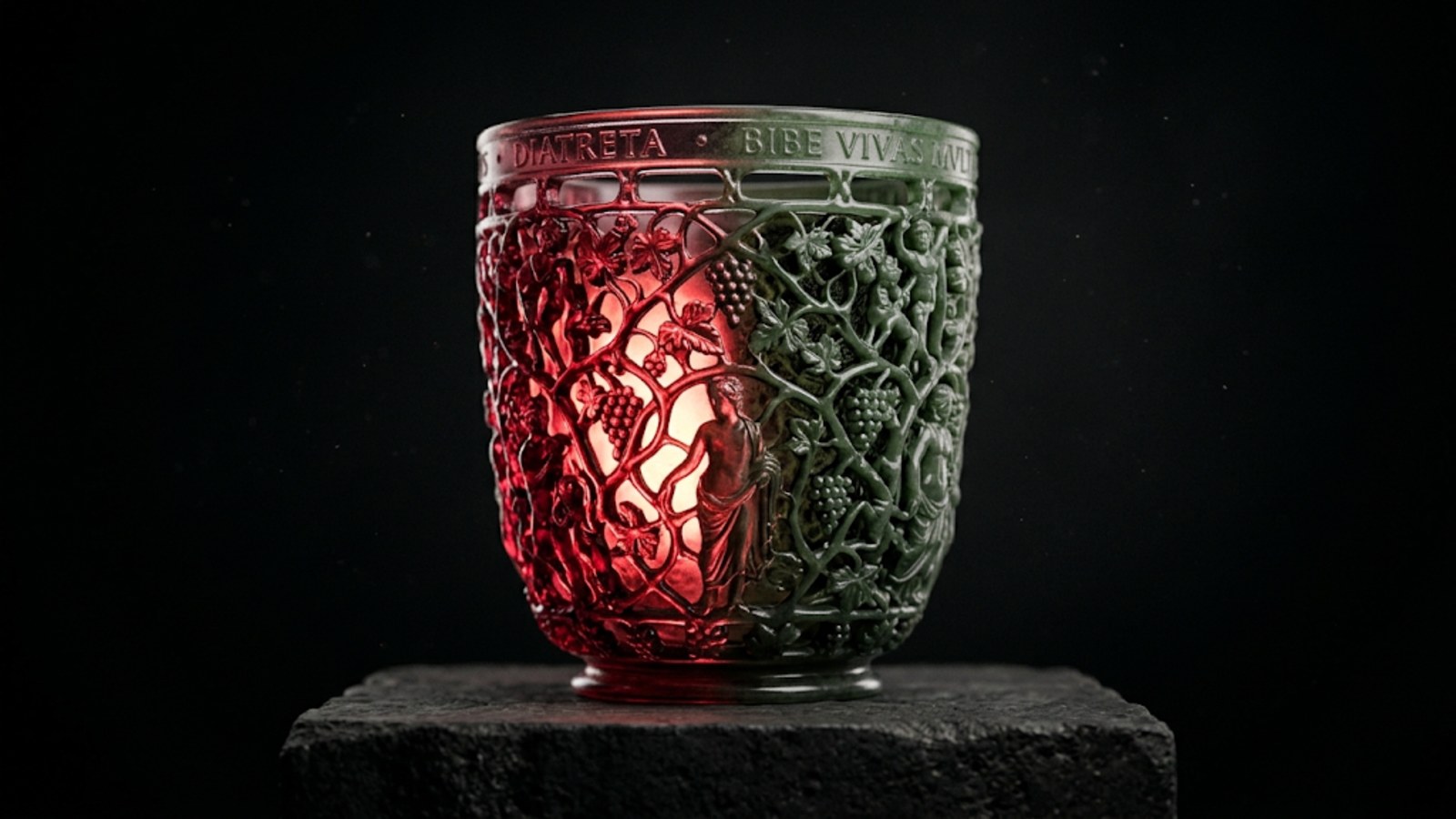
Put the Lycurgus Cup under ordinary room lighting and it looks like a cloudy, jade-green drinking vessel. Shine a light through it from behind or from inside and the whole thing turns a deep, glowing red. It has done this for roughly 1,600 years.
The cup is a Late Roman piece from the 4th century AD, now in the British Museum in London. For a long time nobody could explain the color trick. When scientists finally looked at the glass with an electron microscope, they found something that sounds modern: metal particles measured in nanometers. Here is what the cup is, what it shows, how the effect works and how much the Roman makers likely understood.
Quick facts
| Date | 4th century AD (Late Roman) |
| Where it is | British Museum, London (Room 41) |
| Size | About 15.9 cm tall, 13.2 cm wide, about 700 g |
| Type | Glass cage cup (diatretum) with figures carved in relief |
| Color effect | Green when lit from the front, red when lit from behind |
| What causes it | Silver and gold nanoparticles, about 70 nm across |
| Acquired | Bought from Victor, Lord Rothschild in 1958 for £20,000 |
What Is the Lycurgus Cup?
The Lycurgus Cup is a cage cup, also called a diatretum. Cage cups were among the most difficult luxury objects Roman glassworkers made. The craftsman started with a thick glass blank and then cut and ground most of it away, leaving an outer layer of decoration that stands out from the body of the cup and is joined to it only by small bridges of glass.
Most surviving cage cups carry geometric patterns. The Lycurgus Cup is different because its outer layer is made of human figures. According to its catalog history, it is the only well-preserved figural example of the type, and the only complete Roman object made of dichroic glass, meaning glass that shows two colors depending on the light.
The British Museum lists the cup at about 158.8 mm tall with a maximum diameter of 132 mm and a weight of about 700 grams. The gilt silver rim and the openwork foot decorated with vine leaves are not Roman. They were added much later, probably around 1800.
The Myth Carved Around the Cup
The cup takes its name from the scene on its side. In the myth shown on the cup, King Lycurgus turns against Dionysus, the god of wine. Lycurgus tries to kill Ambrosia, one of the god’s followers. She is transformed into a vine that wraps around the king and traps him, while Dionysus and two companions look on and taunt him.
The figures are carved almost fully free of the cup wall, so the vine really does seem to wrap around the king. The dramatic color shift makes the scene look different depending on how the cup is lit, which is part of why it is so often photographed both ways.
Experts still debate exactly where the cup was made. Suggestions include Alexandria and Rome, and one theory holds that up to three workshops in different parts of the empire were involved, with the raw glass possibly starting life as a block made in Egypt or Palestine.
Why the Glass Turns From Green to Red
For centuries, people could only describe the color change. The explanation came with modern lab tools. Studies of tiny fragments, including a transmission electron microscope study by Barber and Freestone published in 1990, showed that the glass contains extremely small particles of silver and gold scattered through it.
The amounts are tiny. Estimates put the content at about 330 parts per million of silver and 40 parts per million of gold. The particles are roughly 70 nanometers across, far too small to see with an ordinary microscope.
Particles that small interact with light in an unusual way. When light hits the cup from the front, the particles scatter it back toward your eye, and the glass looks a muddy, opaque green. When light passes through the cup from behind, the particles absorb part of the spectrum and let the red end through, so the cup glows red. Same object, same glass, two very different colors.
Dichroic means two colored. Plenty of later glass, such as cranberry glass, uses gold to make red, but it only shows one color. The Lycurgus Cup shows the most dramatic two-way color change known in ancient glass.
Did the Romans Understand Nanotechnology?
Headlines often call the Lycurgus Cup ancient nanotechnology, and a 2007 paper in the journal Gold Bulletin by Ian Freestone and British Museum colleagues used the phrase in its title. It is a fair description of what the glass contains. It is not evidence that Roman workers knew what a nanoparticle was.
The more cautious view is that the makers probably did not fully understand the process. The effect may have come from adding gold and silver to the glass batch, possibly even by accidental contamination, and then discovering that it produced a striking result. Getting the effect requires very precise amounts, which is why so few examples exist.
A handful of other Roman dichroic glass fragments survive, which suggests the effect was known in at least a few workshops. The Metropolitan Museum of Art, for example, holds a small fragment showing a satyr that shifts from olive green to a reddish amber. But no other complete object survives.
From Rothschild Collection to the British Museum
The cup first appears in print in 1845, when a French writer saw it with a M. Dubois. By 1857 it belonged to the banker Lionel de Rothschild. Not every expert was impressed. The art historian Gustav Waagen dismissed it that year as “barbaric and debased.”
It was lent to exhibitions in the mid 1800s and then largely dropped out of scholarly view until 1950, when the first full studies confirmed that it was made of glass rather than a semi-precious stone. In 1958, Victor, Lord Rothschild sold it to the British Museum for £20,000, with £2,000 of that coming from the charity now called the Art Fund.
The museum’s lab removed the later metal foot in 1958 so the cup could be studied, and the two were reunited in 1973. The cup is cracked, so the rim mount has never been taken off.
- 1845: first mention in print
- 1857: owned by Lionel de Rothschild
- 1950: first full scientific studies
- 1958: bought by the British Museum
- 1973: foot and cup rejoined after study
How the Lycurgus Cup Inspires Modern Science
The cup has had a second life in laboratories. In 2013, a team led by Gang Logan Liu at the University of Illinois built a sensor based on the same principle. They made billions of microscopic cup shapes, each about 180 nanometers across and lined with gold and silver particles, on a plastic sheet roughly one square centimeter in size.
When different liquids were added, the sensor changed color in ways that could be seen without special equipment. The team reported that it was at least 100 times more sensitive than most gold nanoparticle solutions. The idea is that cheap, color-changing sensors could one day help test liquids or detect molecules.
Others have recreated the look directly. Corning produced a glass blank with a similar composition that shows the same green-to-red change, and Dutch researchers reported in 2019 and 2020 that they had reproduced the effect in a 3D-printable material containing gold and silver nanoparticles.
What We Know and What Is Still Open
The science of the color change is well understood. The physical object is well documented, measured and dated. What remains uncertain is the human side: exactly where it was made, how many workshops were involved, what the makers knew about their recipe, and who first owned it.
If you want to see it for yourself, the British Museum displays it in Room 41, the gallery covering Europe from AD 300 to 1100. Photos rarely do it justice, because the effect depends on where the light is coming from.
| Question | Status |
|---|---|
| Why does it change color? | Known: metal nanoparticles in the glass |
| When was it made? | Known: 4th century AD |
| Where was it made? | Debated: Rome and Alexandria suggested |
| Did the makers understand it? | Probably not fully |
| Who first owned it? | Unknown |
Frequently asked questions
Why does the Lycurgus Cup change color?
The glass contains tiny particles of silver and gold, about 70 nanometers across. They scatter light back toward you so the cup looks green when lit from the front, and let red light through when it is lit from behind.
Where is the Lycurgus Cup now?
It is in the British Museum in London, displayed in Room 41. The museum bought it from Victor, Lord Rothschild in 1958.
How old is the Lycurgus Cup?
It dates to the 4th century AD, which makes it roughly 1,600 to 1,700 years old. The metal rim and foot were added much later, around 1800.
Is the Lycurgus Cup really nanotechnology?
It does contain nanoparticles, and scientists use it as an early example of the effect. Most experts think the Roman makers did not understand the science and may have found the recipe by trial or accident.
What story is shown on the Lycurgus Cup?
It shows the Greek myth of King Lycurgus, who attacked a follower of Dionysus named Ambrosia. She turned into a vine that trapped him.
Keep reading
Like hidden stories, mysteries and new tech? We cover them every week on The Hidden Secrets YouTube channel.
Sources
- British Museum collection record: date, dimensions, materials, provenance, foot removed 1958 and rejoined 1973, Room 41
- Wikipedia: nanoparticle content and size, myth, possible workshops, provenance history, 1958 price, later reproductions
- Freestone et al. (2007), Gold Bulletin: “The Lycurgus Cup, A Roman nanotechnology” and its references, including Barber and Freestone (1990)
- University of Illinois ECE (2013): Gang Logan Liu’s Lycurgus-inspired color-changing sensor
Last updated October 2026. Featured image is AI-generated for illustration.