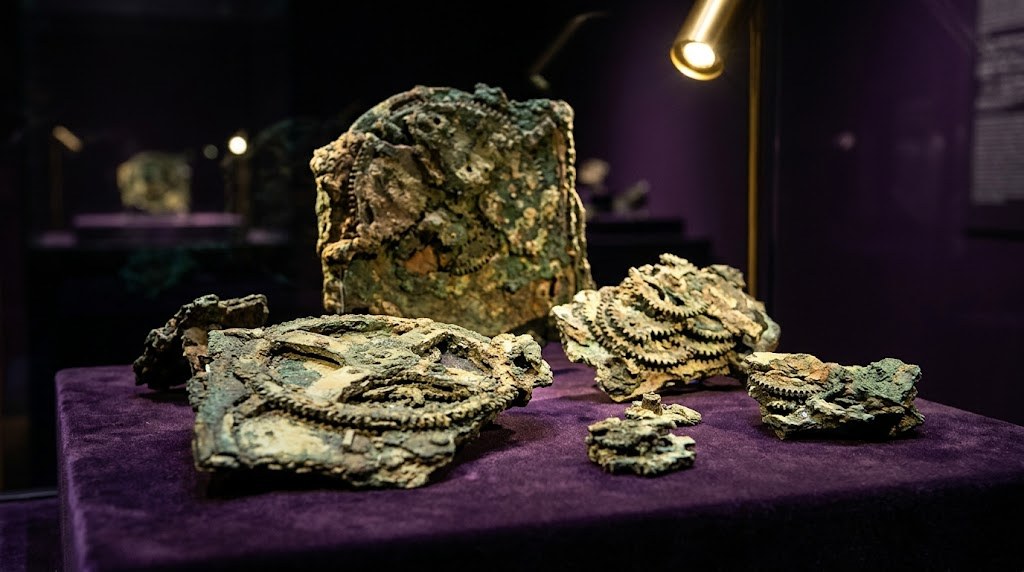
In 1901 Greek sponge divers working off the small island of Antikythera brought up statues, pottery and a shapeless lump of corroded bronze and wood from an ancient shipwreck. Months later someone noticed a gear wheel inside it. That lump turned out to be the most sophisticated machine known from the ancient world, an astronomical calculator often called the first computer.
Quick facts
| Found | 1901, in a shipwreck off Antikythera, Greece |
| Ship sank | Around 70 to 60 BC |
| Built | Probably 2nd or 1st century BC |
| Surviving pieces | 82 fragments with about 30 bronze gears |
| Size | Roughly the size of a shoebox |
| Where to see it | National Archaeological Museum, Athens |
What the machine did
The mechanism was housed in a wooden case with dials on the front and back. Turning a handle drove a train of interlocking bronze gears, some with teeth only about a millimetre or two in size. As the user turned the handle to move through time, the dials showed:
- The position of the Sun and Moon in the zodiac.
- The phase of the Moon, using a small rotating ball that was half dark and half light.
- Predictions of solar and lunar eclipses using the Saros cycle of about 18 years.
- The Metonic cycle of 19 years, which linked lunar months to solar years.
- The timing of athletic games, including the Olympics.
- Very likely the positions of the five planets known in antiquity.
One clever gear arrangement even modelled the Moon's changing speed across the sky, using two gears with a pin and slot, an idea that reflects the astronomy of the Greek scholar Hipparchus.
How it was decoded
Because it was so corroded, the mechanism could not be taken apart. In the 1950s to 1970s, British historian Derek de Solla Price used X rays to count gear teeth and work out its purpose. In 2005 the Antikythera Mechanism Research Project used high resolution CT scanning, which revealed thousands of tiny inscribed characters, effectively a user's manual engraved on the device. In 2021 a team at University College London published a reconstruction of the missing front display, showing how the planets were likely modelled.
Why it is so surprising
Nothing of comparable complexity survives from the ancient world. Geared astronomical clocks of similar sophistication only appear in Europe in the medieval period, more than a thousand years later. This suggests the mechanism was not a one off, but part of a lost tradition of Greek precision engineering that we know almost nothing about.
Who made it?
No one knows. Suggestions include workshops linked to Archimedes, to the island of Rhodes where Hipparchus worked, or to Corinth and its colonies. Inscriptions and calendar names give clues but no clear answer.
Frequently asked questions
Is the Antikythera mechanism a computer?
It is an analogue computer, a mechanical device that calculates astronomical positions through gearing, not an electronic one.
How old is the Antikythera mechanism?
Most estimates place its construction in the 2nd or 1st century BC.
Where is the Antikythera mechanism now?
In the National Archaeological Museum in Athens.
Keep reading
Sources
- Freeth et al., "A Model of the Cosmos in the ancient Greek Antikythera Mechanism", Scientific Reports, 2021
- Antikythera Mechanism Research Project
- Derek de Solla Price, Gears from the Greeks (1974)