
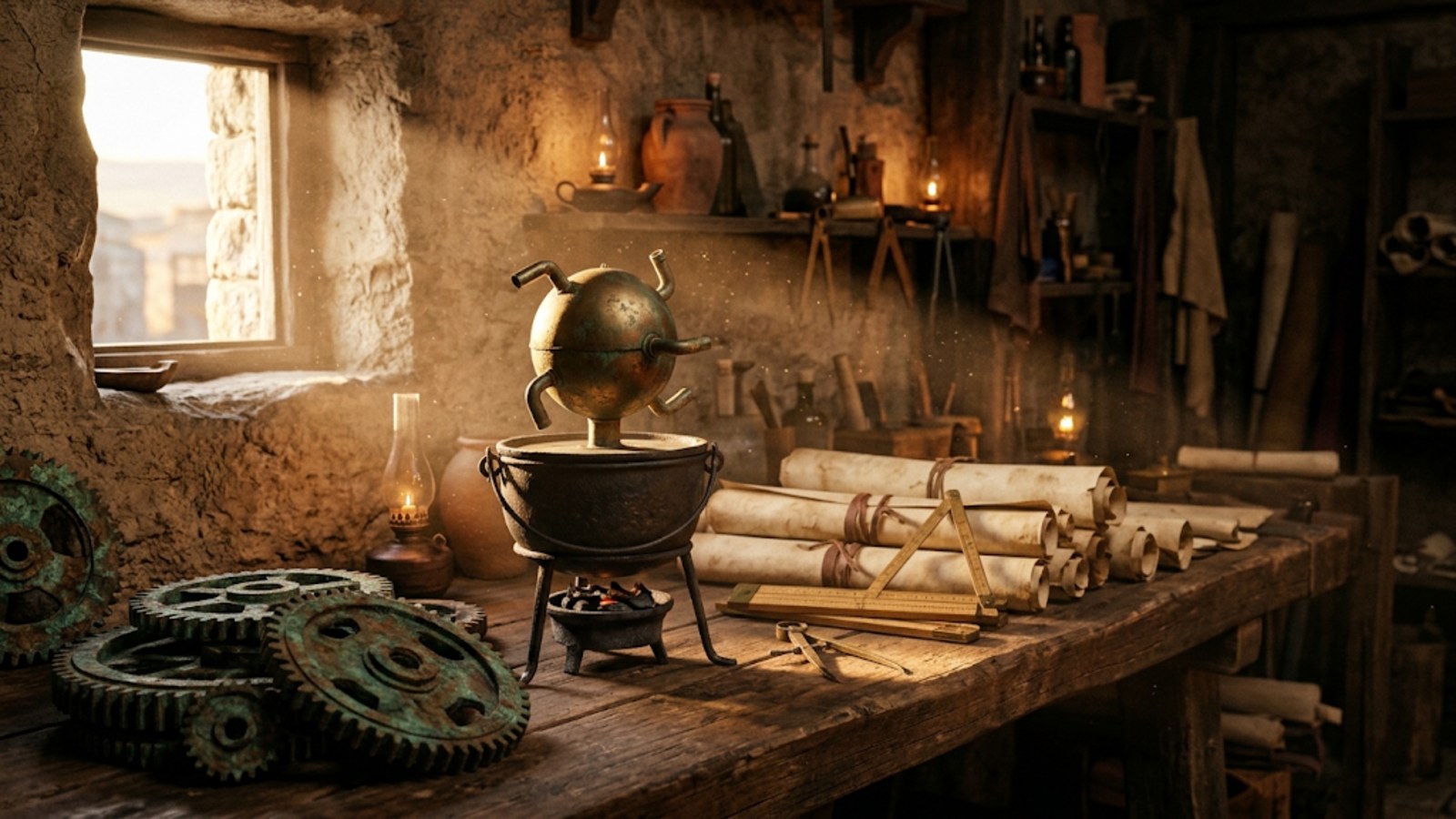
It is easy to assume that clever machines started with the Industrial Revolution. The record says otherwise. Some ancient inventions worked on principles we now link to computers, steam engines, earthquake sensors and modern plumbing, and a few of them took centuries for anyone to match.
This list covers six examples from Greece, Rome, China and the Indus Valley. For each one, we look at what the evidence actually shows and where historians still disagree. Some are well understood. Others survive only as fragments or written descriptions, which leaves plenty of room for debate.
Quick facts
| Inventions covered | 6 |
| Oldest | Indus Valley drainage at Mohenjo-daro (3rd millennium BC) |
| Most complex | Antikythera mechanism (82 surviving fragments) |
| Still standing | The Pantheon in Rome, dedicated in AD 128 |
| Earliest earthquake detector | Zhang Heng’s seismoscope, 132 CE |
| Civilizations | Greek, Roman, Chinese, Indus Valley |
1. The Antikythera Mechanism: A 2,000-Year-Old Calculator
In 1901, divers working a Roman-era shipwreck off the Greek island of Antikythera brought up a lump of corroded bronze. It turned out to be the remains of a device about 2,000 years old, packed with interlocking bronze gears. It survives today in 82 fragments.
Researchers have worked out that the mechanism predicted astronomical events. It tracked the phases of the Moon, the movements of the planets and the timing of solar and lunar eclipses. It even kept track of the dates of the Olympic Games. That is why it is often called the world’s first analog computer.
In 2021, a team at University College London led by Tony Freeth published a new model of its front display in Scientific Reports. Freeth described it as the first model that fits all the physical evidence. The team was open about the open questions, though. Their design needs nested tubes squeezed into a space about 25 millimeters deep, and one co-author doubted the Greeks could have made them.
2. Roman Concrete That Repairs Its Own Cracks
Roman builders made concrete structures that have lasted nearly 2,000 years. The Pantheon in Rome, dedicated in AD 128, still has the world’s largest unreinforced concrete dome. For a long time, the durability was credited mainly to volcanic ash from the area around Pozzuoli, near Naples.
A 2023 study in Science Advances, led by MIT professor Admir Masic, pointed to another ingredient. Roman concrete is full of small white lumps called lime clasts, once dismissed as a sign of sloppy mixing. The team concluded the Romans likely used quicklime in a hot mixing process, and that the clasts were left behind on purpose or as a useful side effect.
Those clasts act as a repair kit. When a crack forms and water seeps in, the water dissolves calcium from the clasts, which then recrystallizes as calcium carbonate and seals the gap. In lab tests, cracked samples made with the hot mixing method healed within two weeks and stopped water from flowing through. A sample made without quicklime never healed.
Why this matters today: if modern concrete could seal its own small cracks the same way, it would in principle need less repair. That is a big part of why engineers study the Roman recipe.
3. Zhang Heng’s Earthquake Detector
In 132 CE, the Han dynasty scientist and mathematician Zhang Heng built a device to detect earthquakes. Historical descriptions say it was a bronze vessel with eight dragon heads around the outside, each holding a bronze ball. Below each dragon sat a toad with its mouth open. When the ground shook, a ball dropped from a dragon into a toad, roughly showing the direction of the quake.
The most famous story says the device once dropped a ball when nobody in the capital had felt anything. Days later, word arrived that an earthquake had struck Longxi, well over 100 miles away.
What we know comes from written records rather than the original instrument, and nobody is certain how the inside worked. Modern replicas, such as one at the Sheshan Seismic Station museum near Shanghai, have not matched the accuracy described in the historical accounts.
4. Hero of Alexandria’s Steam Engine
Hero of Alexandria was a Greek engineer and mathematician, probably active in the 1st or 2nd century AD, though estimates of his dates vary widely. His books describe many machines driven by air, water and steam.
The best known is the aeolipile: a sphere with bent nozzles that spun when steam shot out of them. It is often described as the first recorded steam engine, working on the same reaction principle that pushes a rocket.
Here the evidence calls for caution. There is no clear sign that the aeolipile did useful work. It appears to have been a demonstration or a curiosity rather than a power source. Popular accounts sometimes mix it up with a different Hero device that used air and water to open temple doors.
5. The First Vending Machine and Other Ancient Inventions by Hero
Hero also described what is usually called the first vending machine. A worshipper dropped a coin into a slot. The coin landed on a small pan attached to a lever, and its weight tipped the lever to open a valve that let out a set amount of water for washing. When the coin slid off, a counterweight closed the valve again.
His other designs include a wind wheel that powered an organ, the earliest documented case of wind driving a machine, and automatic temple doors. He also described mechanisms for the theater, including a fully mechanical play that ran for nearly ten minutes and a device for timed thunder effects.
- Pneumatica: machines powered by air, steam or water pressure
- Automata: mechanical devices for banquets and the theater
- Coin-operated water dispenser
- Wind-powered organ
6. Indus Valley Drains, Toilets and the Great Bath
Mohenjo-daro, in what is now Pakistan, was built in the 3rd millennium BC and covered about 240 hectares. UNESCO highlights its streets laid out in a grid and its drainage system with wells and soak pits for sewage. Only about a third of the site has been excavated.
Many houses had their own bathing platforms with watertight floors made of bricks laid on edge, and some drained dirty water out to the street. Multi-story buildings carried water from roofs and upstairs bathrooms down through terracotta pipes or chutes. Toilets were common, although early excavators sometimes mistook them for burial urns or sump pots.
The city’s Great Bath is about 12 meters long, 7 meters wide and up to 2.4 meters deep, reached by two wide staircases. It has been described as the earliest public water tank in the ancient world.
Why Didn’t These Inventions Change the World Sooner?
It is tempting to ask why the Greeks did not start an industrial revolution with Hero’s steam engine. There is no single answer. Several devices on this list seem to have been demonstrations, temple attractions or one-off scientific instruments rather than tools for everyday work. In ancient times, knowledge was copied by hand, so a design described in one book could easily be forgotten.
What these ancient inventions do show is that the basic ideas behind gears, feedback, steam power and sanitation were understood far earlier than most people assume. The people who built them were not short of ingenuity, and that may be the most surprising lesson of all.
| Invention | Place and date | How well understood |
|---|---|---|
| Antikythera mechanism | Greek, about 2,000 years old | Function known, some details debated |
| Self-healing concrete | Roman Empire | Mechanism shown in 2023 lab tests |
| Seismoscope | Han China, 132 CE | Inner workings uncertain |
| Aeolipile | Roman Egypt, 1st or 2nd century AD | Worked, no known practical use |
| Coin water dispenser | Roman Egypt | Described in Hero’s writings |
| Urban drainage | Indus Valley, 3rd millennium BC | Well documented by excavation |
Frequently asked questions
What is the oldest invention in the world?
Simple stone tools are far older than anything on this list. Of the inventions here, the planned drainage of Mohenjo-daro, built in the 3rd millennium BC, is the oldest.
What is the Antikythera mechanism?
It is a geared bronze device about 2,000 years old, found in a shipwreck in 1901. It predicted eclipses, Moon phases and planetary positions, which is why it is called the first analog computer.
Did the ancient Greeks have steam engines?
Hero of Alexandria described the aeolipile, a sphere spun by jets of steam. There is no clear evidence it did useful work, so it was more of a demonstration than an engine.
Why is Roman concrete so strong?
Volcanic ash played a part, and a 2023 MIT-led study found that lime clasts from hot mixing with quicklime let the concrete seal its own cracks when water seeps in.
Who invented the first seismograph?
Zhang Heng built the first known earthquake detector in China in 132 CE. It only showed the rough direction of a quake, so it is better described as a seismoscope than a true seismograph.
Keep reading
- 12 Camping Gadgets on Amazon Actually Worth Buying
- 7 Best-Selling Portable Power Stations
- Best Action Cameras
Like hidden stories, mysteries and new tech? We cover them every week on The Hidden Secrets YouTube channel.
Sources
- Smithsonian Magazine: Antikythera mechanism discovery, functions, 82 fragments, 2021 UCL model
- MIT Civil and Environmental Engineering: 2023 Science Advances study on Roman concrete lime clasts and self-healing
- Atlas Obscura: Zhang Heng’s 132 CE seismoscope, Longxi earthquake story, replicas
- Wikipedia: Hero of Alexandria, aeolipile, coin-operated dispenser, wind organ, automata
- Harappa.com: Mohenjo-daro toilets, bathing platforms, drains and the Great Bath
- UNESCO: Archaeological Ruins at Moenjodaro, date, grid plan, drainage, site size
Last updated October 2026. Featured image is AI-generated for illustration.