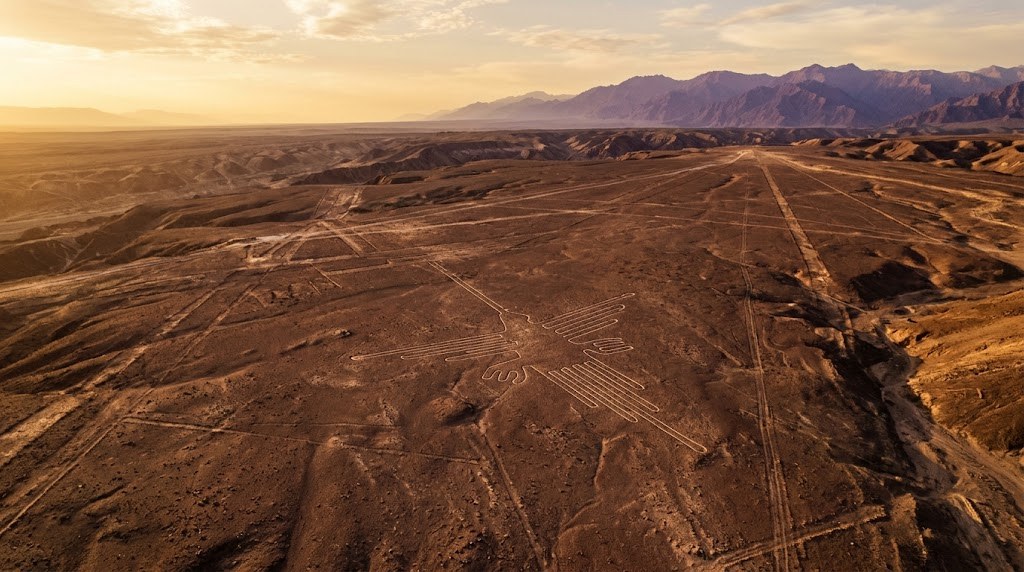
On a dry plateau in southern Peru, ancient people drew a hummingbird the length of a football field, a monkey with a spiral tail, a spider, a condor and hundreds of perfectly straight lines running for kilometres. From the ground they are hard to make out. From the air they are breathtaking. These are the Nazca Lines.
Quick facts
| Location | Nazca and Palpa plains, southern Peru |
| Made by | The Nazca culture, building on earlier Paracas designs |
| Age | Roughly 500 BC to AD 500 |
| What is there | Hundreds of straight lines, geometric shapes and dozens of animal and plant figures |
| Hummingbird size | About 93 m long |
| UNESCO World Heritage | Since 1994 |
How they were made
The desert surface is covered in reddish brown stones darkened by iron oxide. Underneath lies lighter, yellowish ground. The Nazca people simply removed the dark stones along a planned path and piled them at the edges, exposing the paler soil. The method is simple, but the scale and accuracy are impressive. Experiments have shown that a small team using stakes and cords can lay out large figures in days.
Why they survived
The Nazca region is one of the driest places on Earth, with very little rain and little wind at ground level. The stones also absorb heat and create a thin cushion of warm air that helps protect the surface. That is why lines made two thousand years ago are still visible, although vehicles, mining and flooding now threaten parts of the site.
What were they for?
Several ideas have been proposed:
- An astronomical calendar. In the 1940s Paul Kosok and later the German mathematician Maria Reiche, who studied the lines for decades, argued that some lines pointed to solstices and star risings. Later studies found that only a few lines align, so this explains part of the story at best.
- Ritual paths. Many archaeologists now think people walked the lines and figures in processions, possibly as part of ceremonies.
- Water and fertility. In a desert, water was everything. Some lines appear to point towards water sources, and offerings found near them suggest rituals linked to rain.
Claims that the lines were runways for alien spacecraft, made popular in the 1960s, are rejected by scientists. The ground is far too soft for landings, and the figures match images on Nazca pottery and textiles.
New figures are still being found
Discoveries continue. In 2024 researchers from Yamagata University in Japan, working with AI tools to scan aerial images, reported more than 300 previously unknown figures, nearly doubling the number of known figures in just a few months. Many are small, low relief drawings near ancient paths.
How to see them
Most visitors take a short sightseeing flight from Nazca or Pisco. A roadside viewing tower on the Pan American Highway also gives a partial view of a few figures, including the hands and the tree.
Frequently asked questions
Who made the Nazca Lines?
The Nazca people of southern Peru, mainly between about 500 BC and AD 500.
Can you see the Nazca Lines from the ground?
Partly, from nearby hills and a viewing tower, but they are best seen from a plane.
Were the Nazca Lines made by aliens?
No. There is clear evidence they were made by local people using simple tools.
Keep reading
Sources
- UNESCO World Heritage Centre, Lines and Geoglyphs of Nasca and Palpa
- Sakai et al., AI accelerated Nazca survey, PNAS, 2024
- Maria Reiche, Mystery on the Desert (1949)