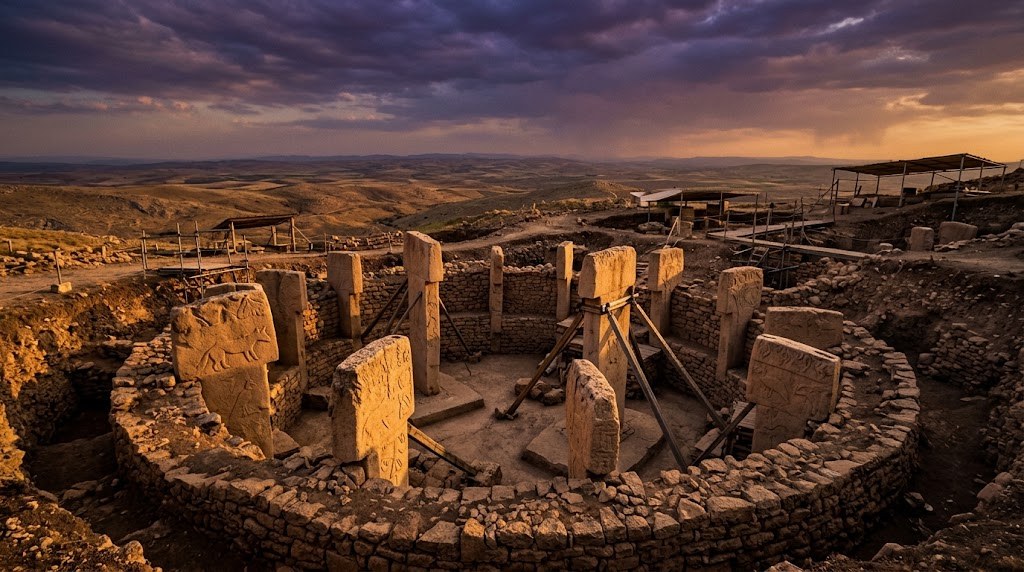
On a hilltop in southeastern Turkey, archaeologists uncovered rings of huge carved stone pillars that are about 11,000 years old. That makes Göbekli Tepe roughly 6,000 years older than Stonehenge and older than farming, pottery and writing. It was built by hunter gatherers, and it has changed how we think civilisation began.
Quick facts
| Location | Near Şanlıurfa, southeastern Turkey |
| Age | About 9600 to 8200 BC |
| Built by | Hunter gatherers, before farming took hold |
| Main features | Circular enclosures of T shaped limestone pillars |
| Tallest pillars | About 5.5 m |
| UNESCO World Heritage | Since 2018 |
How it was discovered
The site was noted in a survey in the 1960s, but researchers took the broken stone slabs for a medieval cemetery. In 1994 German archaeologist Klaus Schmidt looked again and realised the stones were prehistoric. Excavations began in 1995 with the German Archaeological Institute and the Şanlıurfa Museum, and they continue today.
What is there
Göbekli Tepe is made up of several round and oval enclosures. Each is ringed with stone walls and pillars, with two very large pillars standing in the centre. The T shaped pillars appear to represent stylised human figures: some have carved arms, hands and belts. Ground penetrating radar shows many more enclosures still buried under the hill.
The carvings
The pillars are covered in animals carved in relief: foxes, wild boars, snakes, cranes, vultures, scorpions and lions. Most are dangerous or wild creatures rather than animals people would later farm. Their exact meaning is unknown, but many researchers believe they relate to beliefs about death, the wild and the spirit world.
Why it changed history
For a long time the standard story was that people first became farmers, settled in villages and only then had the time and labour to build monuments and temples. Göbekli Tepe flips that order. Here, foragers organised large groups to quarry, carve and raise stones weighing several tonnes, all without metal tools or the wheel. Some archaeologists now argue that gathering at sites like this may have helped push people towards farming, because feeding large crowds required new ways to get food. Interestingly, the region is close to where wild wheat was first domesticated.
Temple or settlement?
Schmidt saw Göbekli Tepe as a ritual centre, perhaps the world's first temple, where people gathered for ceremonies and feasts. More recent digs have found evidence of houses, water cisterns and daily life, so it may also have been lived in. The debate continues, and the discovery of similar sites nearby, such as Karahan Tepe, shows it was part of a wider culture.
Popular theories
Göbekli Tepe attracts plenty of fringe ideas, from lost advanced civilisations to records of an ancient comet impact carved on one pillar. Mainstream archaeologists reject these claims, pointing out that the site's real story, hunter gatherers building monuments, is remarkable enough on its own.
Frequently asked questions
How old is Göbekli Tepe?
Its oldest parts date to around 9600 BC, roughly 11,600 years ago.
Who built Göbekli Tepe?
Hunter gatherer communities of the early Neolithic in the region now called Upper Mesopotamia.
Can you visit Göbekli Tepe?
Yes. It has a visitor centre and covered walkways, and it is about a 20 minute drive from Şanlıurfa.
Keep reading
Sources
- German Archaeological Institute (DAI), Göbekli Tepe research project
- UNESCO World Heritage Centre, Göbekli Tepe listing (2018)
- Klaus Schmidt, Göbekli Tepe: A Stone Age Sanctuary in South Eastern Anatolia