Most photos of Easter Island show giant stone heads poking out of a grassy slope. They look like heads because that is all you can see. The Easter Island statues’ bodies are there too, buried under soil that built up around them over centuries.
This was not a secret to archaeologists, but it surprised a lot of people when excavation photos went viral in 2012. Here is what lies under the famous heads, what the digs found, how old the statues are and what is known about how the Rapa Nui people moved them.
Quick facts
| Statues | Called moai; 887 counted, often described as nearly 1,000 |
| Carved | Most between about AD 1100 and 1500 (estimates vary) |
| Size | Up to about 10 meters tall and up to 80 tons |
| Buried to the shoulders | About 150 statues on the slope of a volcano |
| Key excavation | Easter Island Statue Project, 2010 to 2014 |
| Main quarry | Rano Raraku, source of about 95 percent of moai |
| Location | About 3,200 km off the coast of South America |
Do the Easter Island Statues Have Bodies?
Yes. The moai were carved as full figures with heads and torsos. Statues that ended up on platforms or along the roads were never buried, so their full shape was always visible to anyone on the island.
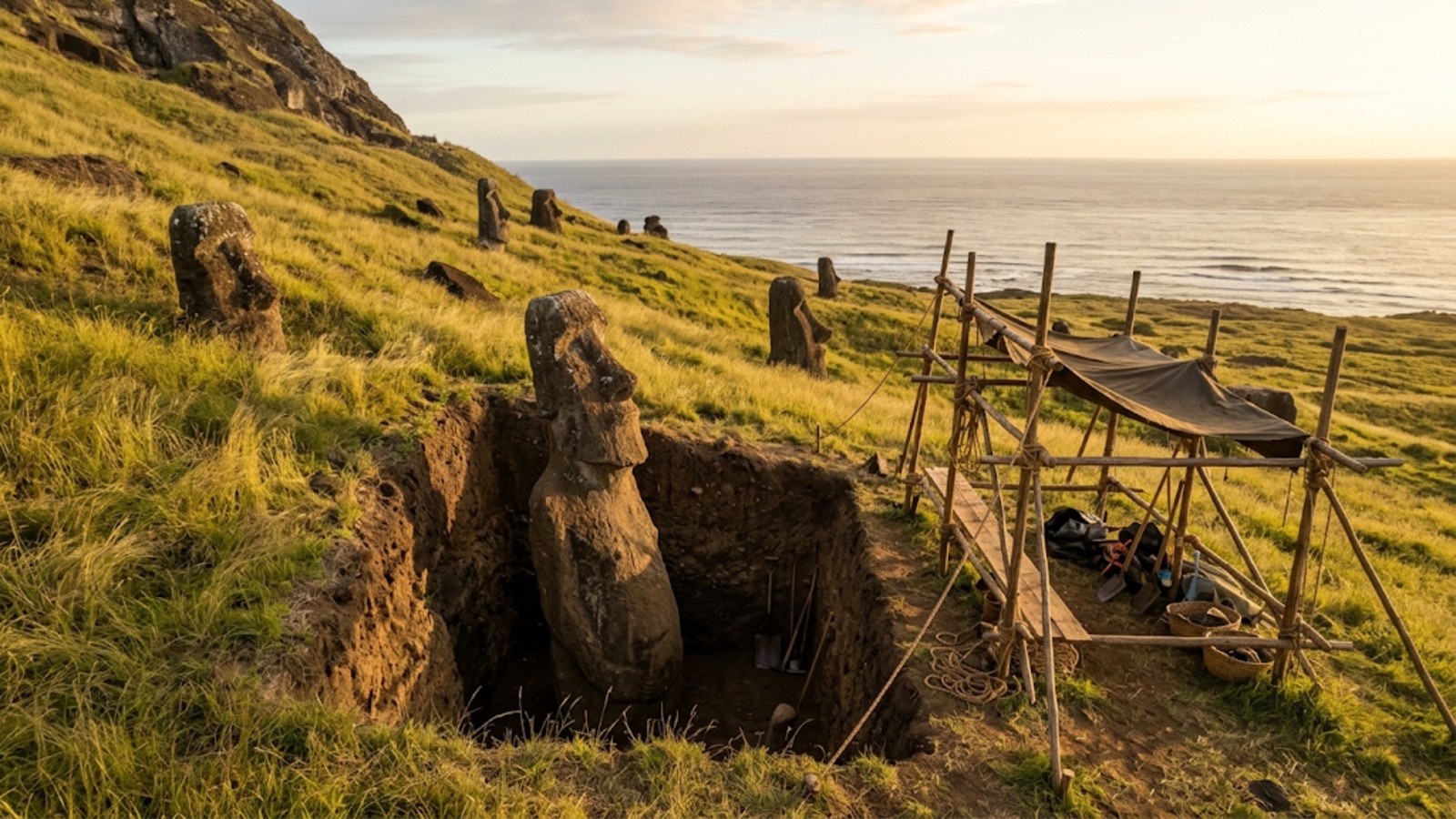
The ones people think of as heads are mostly on the slope of the volcano Rano Raraku. Over the centuries, quarry debris, eroding soil and sediment piled up around them until only the heads and shoulders stayed above ground. Jo Anne Van Tilburg, director of the Easter Island Statue Project, has said there are about 150 statues buried up to the shoulders there.
Those half-buried figures are, in Van Tilburg’s words, “the most famous, most beautiful and most photographed.” That is how the myth of the heads took hold.
When the Easter Island Statues’ Bodies Were First Known
The buried bodies are old news to researchers. According to Live Science, archaeologists knew as early as 1914 that at least some heads sat on underground torsos. An early 20th-century expedition known as the Mana Expedition took photographs showing the statues’ full size, and Thor Heyerdahl’s Norwegian Archaeological Expedition confirmed it in 1955.
What changed in the 2010s was publicity. In 2012, photos from new excavations spread online, and one set was viewed more than a million times on Imgur. For many people, it was the first time they had seen a moai with a body.
What the Excavations Found
From 2010 until late 2014, Van Tilburg and her colleagues excavated statues on the slope. Digging down beside the heads exposed full torsos, confirming that the heads on the slope are the tops of complete statues.
The digs turned up more than stone:
- Carvings on the backs and bases. Soil had protected detailed designs from weathering. These included crescent shapes that some academics interpret as representing the canoes of the first Polynesian settlers.
- Red pigment. The team found about 800 grams of natural red pigment in a burial hole. Van Tilburg thinks it may have been used to paint the statues, much like ceremonial body paint.
- Human burials. Human bones were found throughout the dig, suggesting people buried their dead around the statues.
This was the first excavation to document the complex carvings on the buried bodies in detail. Photos from the project are published on the Easter Island Statue Project website.
Who Carved the Moai and Why
The moai were carved by the Rapa Nui, the Polynesian people of the island. Dates vary by source. Live Science gives AD 1100 to 1500, while other accounts put the main period between 1000 and 1650. All agree most were made several centuries ago, long before Europeans arrived.
Their exact purpose is still debated. They are widely seen as symbols of religious and political authority. Van Tilburg has suggested a moai was likely made when an important tribal figure died.
Rano Raraku: Where the Moai Were Made
The volcano slope with the famous buried heads is Rano Raraku, a crater made of hardened volcanic ash called tuff. It served as the island’s main quarry for about 500 years, until the early 1700s, and supplied the stone for roughly 95 percent of the known moai.
The quarry is full of unfinished work. Some statues are still attached to the rock high on the crater wall. The largest is 21.6 meters (71 feet) long and would have weighed an estimated 270 tonnes, almost twice the height of any completed moai. The statues buried to their shoulders on the outer slopes sit in quarry debris and sediment, and they lack hollowed eye sockets.
That leaves the big practical question. Finished statues had to travel from the quarry to sites across the island. A large one can weigh up to 80 tons. When Captain James Cook visited in 1774, he wrote that he could hardly imagine how the islanders raised such huge statues without mechanical power.
How Were the Moai Moved? Sledges, Rollers and Walking
For decades, the most common idea was that the statues were laid down and dragged, on wooden sledges or over logs used as rollers. Experiments showed that could work. Rapa Nui oral tradition says something else: that the statues walked from the quarry.
Archaeologists Terry Hunt and Carl Lipo took that tradition literally. In 2012, with National Geographic funding, they had as few as 18 people move a 3-meter, five-ton replica upright using three ropes. Teams on either side rocked it from side to side while a rear team kept it from tipping, so it shuffled forward in a zig-zag.
| Test | Year | Method | Result |
|---|---|---|---|
| Pavel Pavel with Thor Heyerdahl | 1986 | Twisting motions | Moved a 9-ton moai, but damaged its base and stopped |
| Charles Love | 1987 | Wooden sledge over log rollers | 25 people moved a 9-ton model 45 meters in two minutes |
| Hunt and Lipo | 2012 | Upright, rocked with three ropes | 18 people moved a 5-ton replica a few hundred meters |
| Lipo and Hunt | 2025 paper | Upright, rocked, with a forward-leaning replica | 18 people moved a 4.35-ton replica 100 meters in 40 minutes |
None of these tests proves how the ancient Rapa Nui did it. They show which methods are physically possible with the people and materials available.
The 2025 Walking Moai Study
In late 2025, Lipo and Hunt published their fullest case yet in the Journal of Archaeological Science. They analyzed 962 moai, focusing on 62 found along the island’s ancient roads, using 3D models and field trials.
The road statues look different from those erected on coastal platforms. They have wide, D-shaped bases and lean forward, features the authors say suit an upright rocking motion. The roads themselves are about 4.5 meters wide with a slightly concave cross-section, which would help keep a rocking statue on track.
They also point to where the road statues lie. About 51.6 percent are within 2 kilometers of Rano Raraku, a pattern they read as statues that broke or fell in transit rather than ones placed on purpose. The paper was written partly as a reply to critics, who have raised questions about the terrain, the supply of rope, weathering of the statues and alternative methods. The walking idea now has strong experimental support, but the debate is not fully closed.
Common Myths About the Heads
A few misunderstandings come up again and again when people first learn the statues have bodies.
- Myth: the moai are only heads. They were carved as full figures. The heads-only look comes from the buried group on the volcano slope.
- Myth: someone buried them deliberately. The burial was gradual, caused by eroding soil and sediment over many centuries.
- Myth: the bodies were a recent discovery. Researchers knew by about 1914. The 2010s excavations documented them in far more detail.
- Myth: all the statues still stand where they were placed. Many were toppled during clan conflicts, roughly between 1600 and 1700, and others have been moved since.
The island has been studied by archaeologists for well over a century, and the moai are still yielding new details, mostly from the parts that have stayed underground.
Frequently asked questions
Do all Easter Island statues have bodies?
The moai were carved as full figures with torsos. About 150 on the slope of Rano Raraku are buried to the shoulders, so only their heads show.
How deep are the Easter Island statue bodies buried?
The roughly 150 statues on the volcano slope are buried up to the shoulders, so most of each torso sits underground.
When did people find out the Easter Island heads have bodies?
Archaeologists knew by about 1914, and Thor Heyerdahl’s expedition confirmed it in 1955. Most of the public learned about it from excavation photos in 2012.
How many moai are on Easter Island?
Counts commonly cited are 887 statues, though many sources round this to nearly 1,000.
How were the Easter Island statues moved?
The leading explanation is that teams with ropes rocked them upright so they “walked” forward, as Rapa Nui tradition says. Experiments in 2012 and a 2025 study by Lipo and Hunt support this, though some researchers still debate it.
Keep reading
Like hidden stories, mysteries and new tech? We cover them every week on The Hidden Secrets YouTube channel.
Sources
- ExplorersWeb: 1914 knowledge, 2010 to 2014 excavation, carving dates, size, Cook’s remark
- The Coconet: 887 statues, about 150 buried, Van Tilburg quote, crescent markings, Mana Expedition and Heyerdahl
- Truth or Fiction: red pigment, human burials, clan-war toppling, statue function
- Wikipedia: Rano Raraku quarry, 95 percent of moai, largest unfinished statue, buried statues
- National Geographic: 2012 walking experiment, Pavel Pavel 1986 and Charles Love 1987 tests
- University of Arizona: Lipo and Hunt 2025 Journal of Archaeological Science paper on the walking moai
Last updated October 2026. Featured image is AI-generated for illustration.