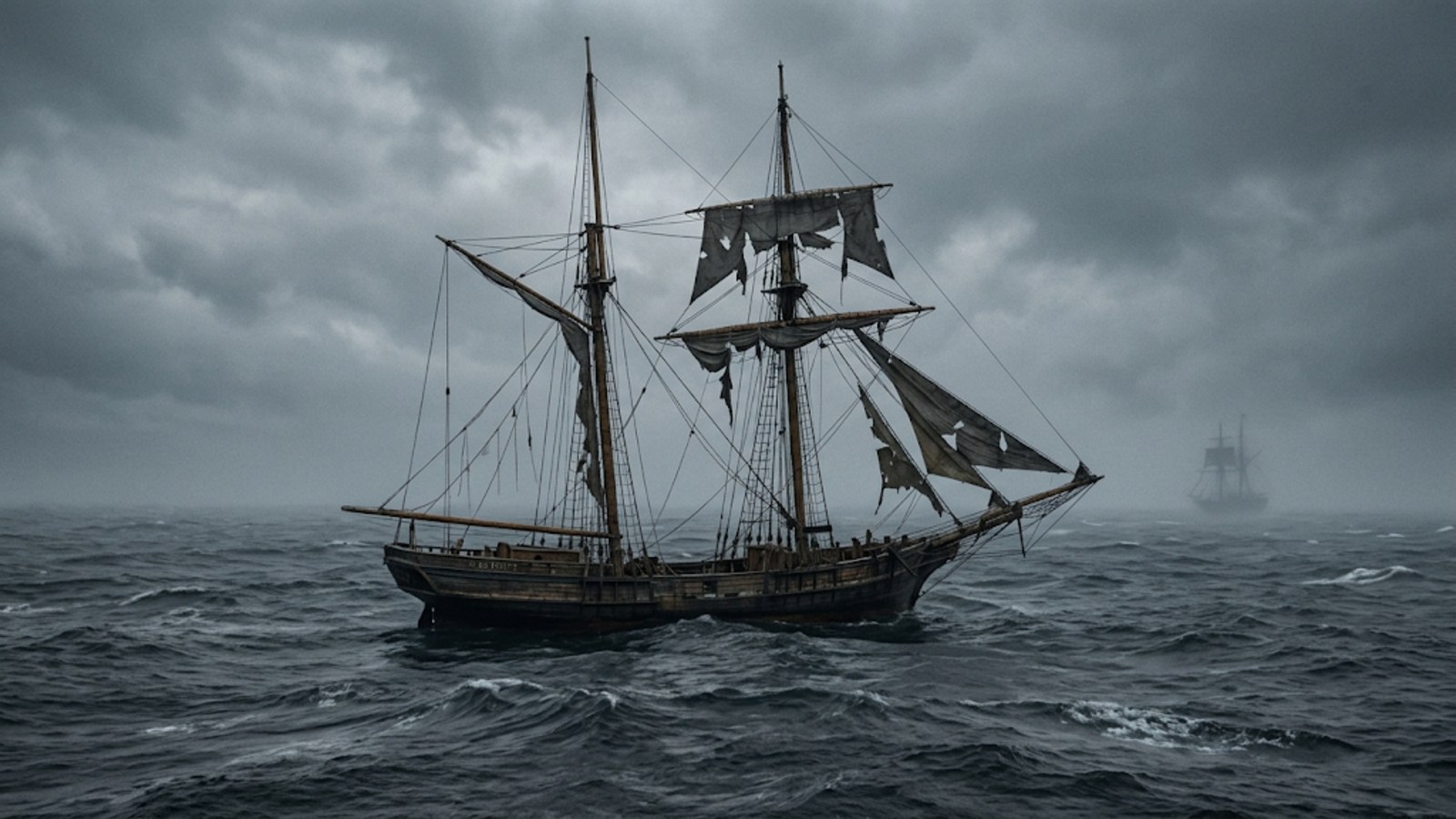
In early December 1872, the crew of the Dei Gratia spotted a ship drifting in the Atlantic, somewhere between the Azores and Portugal. When they boarded, they found the American ship Mary Celeste in reasonable shape, still loaded with cargo and stocked with food. Everyone aboard had vanished.
More than 150 years later, the crew’s fate has never been confirmed. The ship has inspired fiction, fraud and countless theories. Some can be ruled out. One modern explanation fits the evidence better than the rest, but none has been proven.
Quick facts
| Built | 1861, Spencer’s Island, Nova Scotia, as the Amazon |
| Final voyage | Left New York for Genoa, Italy, November 7, 1872 |
| People aboard | 10: Captain Benjamin Briggs, his wife, daughter and seven crew |
| Cargo | 1,701 barrels of alcohol |
| Found | December 4, 1872, by the Dei Gratia (some accounts say December 5) |
| Last log entry | November 25, 1872, near Santa Maria Island, Azores |
| Fate of the ship | Deliberately wrecked off Haiti in 1885 |
The Mary Celeste before the mystery
The ship began life as the Amazon, launched at Spencer’s Island, Nova Scotia, in 1861. Her early career was not lucky. In 1867 she was wrecked off Cape Breton, then salvaged and sold. In 1868 she was registered in New York under a new American owner and renamed Mary Celeste.
By 1872 she had just been extensively refitted. Her previous voyage had carried coal. On November 7, 1872, she sailed from New York bound for Genoa with 1,701 barrels of alcohol in the hold.
Who was on board
The captain was Benjamin Spooner Briggs, an experienced and well-respected mariner. He brought his wife, Sarah, and their two-year-old daughter, Sophia. Their son, Arthur, stayed behind in Marion, Massachusetts, to go to school.
Seven crew made up the rest of the company, for ten people in all. Two of the sailors, the Lorenzen brothers, had lost their belongings in an earlier shipwreck, a detail that later mattered when people accused the crew of murder and theft.
What the Dei Gratia found
On December 4, 1872, by most accounts, the Dei Gratia under Captain David Morehouse came across the Mary Celeste drifting with no one at the wheel. The boarding party found a ship that was battered but far from sinking.
Two details stand out to modern investigators. The dismantled pump suggests someone was trying to fix it. The sounding rod suggests someone was trying to measure how much water was in the hull by hand. Without a working pump, the crew would have had no reliable way to tell whether the ship was taking on water fast or slowly.
- Some sails were set and damaged, and the rigging hung loose
- About 3.5 feet of water sloshed in the hold, not enough to sink her
- The cargo of alcohol was largely intact
- There was roughly six months’ worth of food and water
- The only lifeboat, a small yawl, was missing
- One of the two pumps had been taken apart
- A makeshift sounding rod, used to measure water in the hold, lay on deck
The last entry in the log was written at 5 a.m. on November 25, 1872, near Santa Maria Island in the Azores. The ship was found nearly 400 nautical miles from that spot, meaning she had sailed on alone for days.
The Gibraltar inquiry
The Dei Gratia crew sailed the Mary Celeste to Gibraltar and claimed salvage. The hearings were led by Frederick Solly-Flood, who suspected foul play. He floated the idea that the crew got drunk on the cargo and murdered the Briggs family, or that the two captains had plotted an insurance fraud.
The evidence did not back him up. Stains on board that looked suspicious turned out not to be blood. In the end the salvors received £1,700, about one-fifth of the value of the ship and cargo. That was far less than they had expected.
The theories, from weak to strong
Over the years, people have proposed almost every possible explanation. Some are easy to dismiss.
| Theory | Why it struggles |
|---|---|
| Pirates | The ship, cargo and personal belongings were left untouched |
| Drunken mutiny | Descendants of the crew rejected it, and nothing on board suggested violence |
| Murder by the crew | The Lorenzen brothers had little to gain and had already lost their gear in a wreck |
| Plot with the Dei Gratia | Proposed in 1931, but no evidence of collusion has emerged |
| Alcohol fumes or explosion | The main hatch was secured and the boarding crew reported no fumes |
| Waterspout or seaquake | Possible, but nothing on board proves it |
| Sea monsters or the paranormal | No evidence at all |
The leading theory: a ship abandoned by mistake
The explanation that fits best comes from documentary maker Anne MacGregor, who began investigating in 2002 and presented her findings in a 2007 Smithsonian Channel documentary. She worked with Woods Hole oceanographer Phil Richardson, who used historical wind and ocean data to reconstruct how the empty ship could have drifted from the Azores to the place where the Dei Gratia found her, roughly 400 miles east of the islands. Her film was titled The True Story of the Mary Celeste.
Her case rests on two problems. First, Briggs’s chronometer was probably faulty. That would have put him about 120 miles west of where he thought he was, so he expected to see land three days before he actually did. Second, the recent refit may have left coal dust and construction debris in the hull, which could have clogged the pumps. That would explain the dismantled pump and the improvised sounding rod.
Put those together after a spell of rough weather, and you have a careful captain who cannot tell how much water is in his hull, thinks his ship may be sinking and sees land at last. On the morning of November 25, within sight of Santa Maria Island, Briggs may have ordered everyone into the yawl. MacGregor stressed his good record: “There was never a question that he would do something irrational.”
If the small boat was swept away from the ship or swamped, all ten people would have been lost at sea. It is a sad, ordinary answer, and it remains a theory.
It would also explain the details that made the case famous. On this reading, the food, cargo and belongings were left behind because the crew expected to reach land within hours, and the missing lifeboat points to a hurried but deliberate departure rather than violence. Untouched personal possessions fit that picture better than piracy or mutiny ever did.
How the Mary Celeste became a legend
In 1884 Arthur Conan Doyle published a short story, J. Habakuk Jephson’s Statement, that fictionalized the case and called the ship the Marie Celeste. The story popularized that misspelling, which still turns up today.
The real ship had a grim ending. In January 1885, Captain Gilman C. Parker deliberately ran her onto a reef near Port-au-Prince, Haiti, as part of an insurance fraud. He was tried, and his reputation was ruined. In 2001, an expedition backed by author Clive Cussler said it had found the wreck on the Rochelois reef, but tree-ring dating later showed the timber came from trees that were still growing years after the Mary Celeste was lost.
Frequently asked questions
What happened to the crew of the Mary Celeste?
No one knows for certain. The leading theory is that Captain Briggs ordered the ship abandoned in the lifeboat, wrongly believing it was sinking, and the boat was lost at sea.
Was anyone found on the Mary Celeste?
No. All ten people aboard were missing when the Dei Gratia found the ship in December 1872, and none was ever seen again.
Is the Mary Celeste wreck found?
A 2001 expedition claimed to find it off Haiti, but tree-ring dating of the timber undermined that claim. The ship was deliberately wrecked there in 1885.
Why is it sometimes called the Marie Celeste?
Arthur Conan Doyle used the name Marie Celeste in his 1884 short story about the case, and the misspelling stuck.
What was the Mary Celeste carrying?
She carried 1,701 barrels of alcohol from New York to Genoa, Italy. The cargo was largely intact when she was found.
Keep reading
Like hidden stories, mysteries and new tech? We cover them every week on The Hidden Secrets YouTube channel.
Sources
- Wikipedia: ship history, final voyage, discovery, Gibraltar hearings, theories, fiction and later fate
- Smithsonian Magazine: Anne MacGregor’s investigation, pump and chronometer theory, condition of the ship
- The Canadian Encyclopedia: building in Nova Scotia, 1867 wreck and renaming
Last updated October 2026. Featured image is AI-generated for illustration.