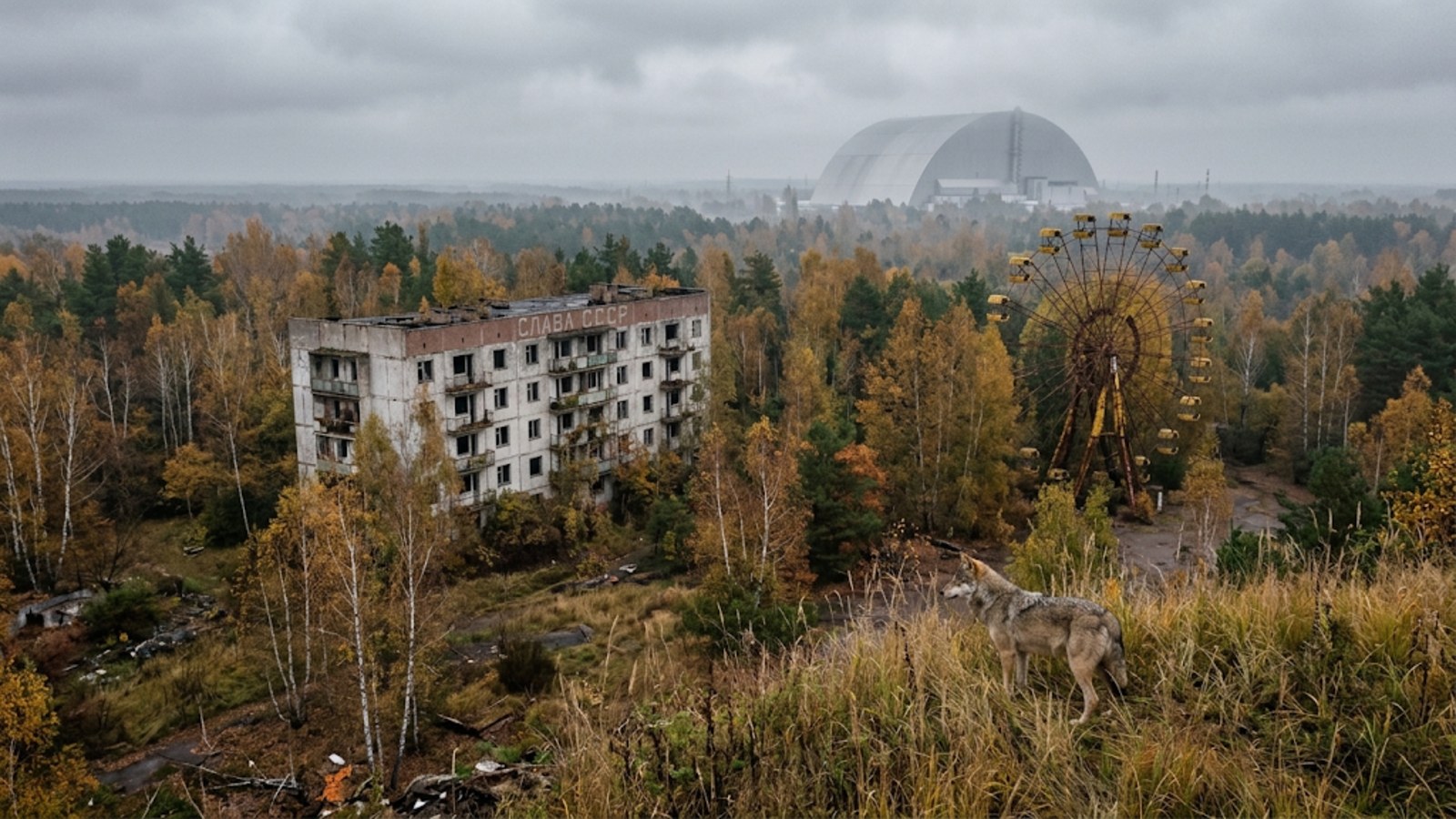
Chernobyl today is not the frozen ghost town many people picture. It is a working industrial site, a nature reserve, a war zone that was occupied in 2022, and, until the full-scale invasion, one of Eastern Europe’s most unusual tourist draws. On 26 April 2026 Ukraine marked 40 years since Reactor 4 exploded.
The short version: the zone is still closed to tourists, the huge steel arch over the reactor was hit by a drone in February 2025 and has not fully recovered, and wildlife keeps doing surprisingly well in the absence of people. Here is what we know as of October 2026.
Quick facts
| Disaster date | 26 April 1986, Reactor 4 |
| Zone size | About 2,600 km² (1,000 sq mi) |
| Original radius | 30 km around the plant |
| Tourism | Suspended since 11 April 2022 under martial law |
| Visitors in 2019 | About 124,000 |
| Shelter status | Damaged by a drone strike on 14 February 2025 |
| 40th anniversary | 26 April 2026 |
Chernobyl today: what the exclusion zone is now
The exclusion zone covers roughly 2,600 square kilometers of northern Ukraine. It began as a 30 km circle drawn around the plant in the days after the accident, a line that was fairly arbitrary at the time. Today it is run by Ukraine’s State Agency on Exclusion Zone Management, while the power plant and its shelter are managed separately.
Before 1986, about 120,000 people lived in the area. Almost all were evacuated. A small group of mostly elderly residents, known as self-settlers, came back anyway. Estimates put their number at fewer than 200, spread across a handful of villages and the town of Chernobyl itself, with an average age in the 60s.
In 2016 the Ukrainian side of the zone was declared the Chernobyl Radiation and Environmental Biosphere Reserve, which tells you how officials now see much of the land: as a place to monitor and protect rather than reclaim.
Can you visit Chernobyl in 2026?
No. Tour operators had been bringing visitors in since 2011, and by 2019 numbers had reached about 124,000 a year, according to Ukrinform. The UK sent the most visitors, around 18,000, and the US about 6,500.
Then came the war. Russian forces captured the plant on 24 February 2022, the first day of the full-scale invasion, and held it for about five weeks before withdrawing. On 11 April 2022, Ukraine suspended entry passes for the duration of martial law. The zone remained closed to tourists as of April 2026.
The occupation left its own marks. Ukrainian reports said radiation readings rose after the invasion, possibly because military vehicles stirred up contaminated dust. On 27 March 2022, a Ukrainian official reported 31 fires covering about 10,000 hectares that firefighters could not reach.
In 2023, Ukraine’s environment minister said he did not expect tourism to return until martial law ends, and pointed to landmines as a key safety problem. That is still the clearest official signal on when tours might restart.
Any company selling Chernobyl tours for dates in 2026 should be treated with caution. Entry depends on official passes that have been suspended since April 2022.
The drone strike on the New Safe Confinement
The New Safe Confinement is the giant steel arch that covers the ruined reactor. It cost about €1.5 billion and was designed to hold in radioactive material while the old Soviet sarcophagus underneath is taken apart.
On 14 February 2025, a drone struck the arch and punched a large hole through its outer shell. Ukraine says it was an Iranian-designed Shahed drone. The fire in the cladding smoldered until 3 March, 17 days later. Emergency crews, working in shifts in temperatures below minus 10°C, had to cut more holes to reach it.
In December 2025, the International Atomic Energy Agency said the structure had lost its primary safety functions, including confinement. The good news in the same assessment: no permanent damage to the load-bearing structure or the monitoring systems. IAEA chief Rafael Grossi said the building’s structure itself was not compromised.
| Phase | What it involves | Cost or status |
|---|---|---|
| Emergency repair | Metal sheet over the main breach | Finished early October 2025 |
| Interim repair | Sealing punctures, restoring part of the membrane | Planned for 2026, about €5 to €10 million |
| Full restoration | Bringing back all confinement functions | Estimated at more than €500 million by the EBRD |
Radiation: how dangerous is the zone now?
The zone remains one of the most contaminated places on Earth, but the danger is uneven. Some patches are very hot, while other areas have recovered enough that, in May 2025, about 100 hectares were reported to have dropped to contamination levels considered safe for farming.
Near the reactor the picture is very different. Nuclear safety expert Simon Evans told the Irish Times that a worker standing on top of the damaged arch would hit the maximum annual dose of 20 millisieverts in about 11 hours. That is why repair crews carry dosimeters and rotate out once they reach their limit.
Fire is the other wildcard, because burning vegetation can lift contaminated particles back into the air. A 2020 wildfire raised background radiation in the zone. On 7 May 2026, another fire broke out after a drone crashed near the plant and grew to about 1,100 hectares. Authorities said radiation stayed within normal limits, but strong winds and landmines made the blaze hard to fight.
Wolves, bison and wild horses
With people gone, large animals moved in. Wolves, lynx, European bison, Przewalski’s horses and brown bears have all been reported in the zone. Some writers call it an involuntary park.
Scientists still argue about what radiation is doing to these animals. Some studies link it to fewer birds and smaller bird brains. Others find thriving populations. Both can be true at once: the benefit of no humans may outweigh the cost of radiation for some species.
The most talked-about recent work comes from Princeton biologist Cara Love, who has studied Chernobyl’s wolves since 2014. Her team found the wolves have altered immune systems and genetic regions that may offer some resilience to cancer. The wolves absorb more than 11.28 millirem a day, over six times the legal limit for a human worker. Love has been careful to frame the cancer link as a possibility rather than a proven result.
Key moments since 2022
A lot has happened in a short time. These are the events that shaped the zone as it is now.
- 24 February 2022: Russian forces capture the plant on the first day of the invasion
- Around 31 March 2022: most Russian troops withdraw, and Ukraine retakes the site in early April
- 11 April 2022: entry passes for visitors are suspended under martial law
- 14 February 2025: a drone tears a hole in the New Safe Confinement
- May 2025: about 100 hectares are reported safe enough for farming
- Early October 2025: emergency repairs cover the main breach
- December 2025: the IAEA says the shelter has lost its confinement function
- 26 April 2026: Ukraine marks the 40th anniversary of the disaster
- 7 May 2026: a fire after a drone crash burns about 1,100 hectares
What happens next
The near-term priority is the arch. EBRD officials have warned that without proper repairs, corrosion could set in by the end of this decade. The international fund that pays for Chernobyl work holds a little over €70 million, far short of the full repair bill, and Ukraine is raising money from donors.
Meanwhile, dismantling of the old sarcophagus is on hold, and the war keeps adding new risks, from drones overhead to mines in the forest. For now, Chernobyl today is a place to read about rather than visit.
Frequently asked questions
Is Chernobyl still radioactive today?
Yes. Contamination is patchy, with some areas close to normal background and others, especially near the reactor, still dangerous. Officials monitor levels constantly, especially during wildfires.
Can tourists go to Chernobyl right now?
No. Entry passes have been suspended since 11 April 2022 under martial law, and the zone was still closed to tourists as of April 2026.
Do people live in Chernobyl?
A small number do. Fewer than 200 elderly self-settlers live in villages inside the zone, alongside shift workers at the plant.
What happened to the Chernobyl shelter in 2025?
A drone hit the New Safe Confinement on 14 February 2025, tearing a hole in its roof. The IAEA later said it had lost its confinement function, though its main structure was intact.
Are there animals in Chernobyl?
Yes. Wolves, lynx, bison, Przewalski’s horses and brown bears have been recorded, and researchers are studying how radiation affects them.
Keep reading
Like hidden stories, mysteries and new tech? We cover them every week on The Hidden Secrets YouTube channel.
Sources
- Wikipedia: zone size, residents, tourism suspension, occupation dates, wildlife, 2016 reserve, 2025 farmland
- Irish Times: drone strike details, repair phases and costs, worker radiation doses
- NucNet: IAEA December 2025 assessment of the New Safe Confinement
- Euronews: May 2026 forest fire after drone crash
- Ukrinform: 124,000 visitors in 2019 and top countries
- Interesting Engineering: Cara Love’s wolf research
Last updated October 2026. Featured image is AI-generated for illustration.