
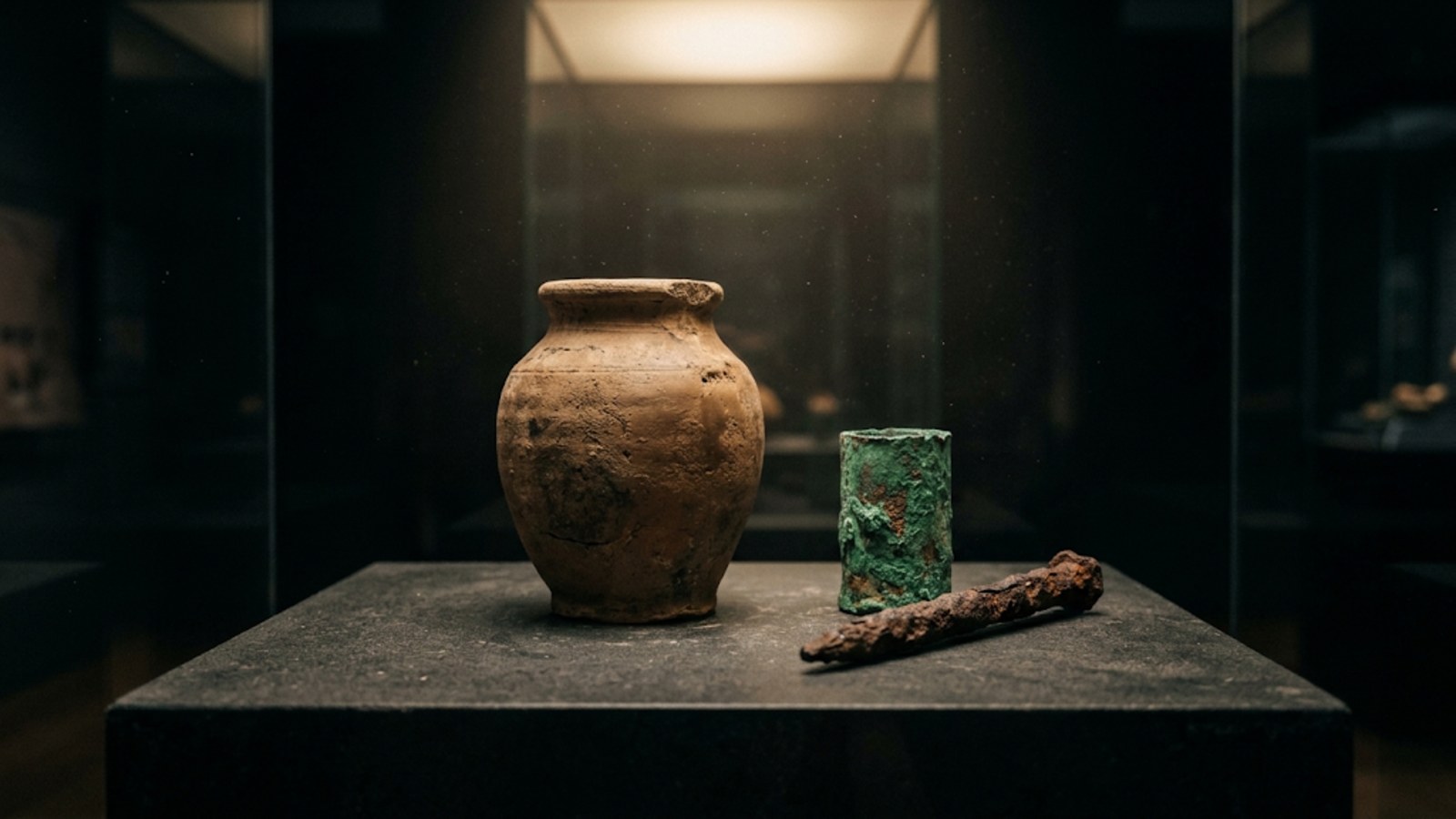
The Baghdad battery is one of the most famous objects in alternative history. It is a small clay jar, found in Iraq in the 1930s, that held a copper cylinder with an iron rod inside. Put an acidic liquid in it and, in theory, you get a weak electric current.
That idea has inspired documentaries, TV experiments and plenty of wild claims about ancient technology. But most archaeologists think the jar was never a battery at all. Here is what the object actually is, what the tests showed, and why the electric theory struggles.
Quick facts
| What it is | A clay jar holding a copper cylinder and an iron rod, sealed with bitumen (asphalt) |
| Where found | Khujut Rabu, near Baghdad, close to ancient Ctesiphon |
| When found | 1936, during excavations; described by Wilhelm König in 1938 |
| Size | Roughly 13 to 15 cm tall (about 5 to 6 inches) |
| Age | Parthian or Sasanian period, roughly 2,000 to 1,500 years old |
| Current location | Unknown since the 2003 invasion of Iraq |
What the Baghdad battery actually is
The object has three parts. The outer part is a terracotta jar about five to six inches tall. Inside sits a tube of rolled copper sheet, closed at the bottom with a copper disk. Inside the tube is an iron rod, held in place by a plug of asphalt.
According to measurements from researcher Paul Keyser, cited by Today I Found Out, the copper tube is about 9.8 cm long and 2.6 cm wide, and the iron rod is about 7.5 cm long. Early examiners reported corrosion on the copper, which some took as a sign that an acidic liquid such as vinegar or wine had once been inside.
Published sizes vary a little, from about 13 cm to 15 cm tall, depending on the source. That is typical for an object that has been described secondhand for decades.
Who found it, and when
The jar came from Khujut Rabu, a site near Baghdad and close to the ancient city of Ctesiphon. Most sources date the find to 1936. Some later articles give 1938, which is the year the German archaeologist Wilhelm König examined it.
König was the first to suggest it might be a galvanic cell. He linked it to other sealed jars with metal rolls found in the region and proposed that several cells could have been used for electroplating, coating objects with a thin layer of gold or silver.
The dating is also debated. It was first attributed to the Parthian period, roughly 250 BC to AD 224. Dr St John Simpson of the British Museum has said the pottery itself looks Sasanian, which would make it a few centuries younger.
Can it make electricity?
Yes, a copy can. That part is not in dispute. Copper and iron in an acidic liquid form a simple cell, the same chemistry behind a classroom lemon battery.
Replicas have produced small voltages. After König’s idea appeared in print in the late 1930s, an engineer named Willard Gray, working for General Electric in Pittsfield, Massachusetts, built a copy and got about half a volt using copper sulfate. A later German test in 1970 reported 0.87 volts using grape juice. Other reports give figures up to around two volts.
In 2005 the TV show MythBusters built ten replica jars, filled them with lemon juice and wired them in series. Together they produced 4.33 volts, enough to faintly electroplate a small token and to deliver a painful tingle through acupuncture-style needles.
Producing a current from a replica proves the chemistry works. It does not prove anyone in the ancient world used it that way.
The case against the battery theory
Most archaeologists reject the electric explanation, and their reasons are practical.
- No sign of connections. There is no archaeological evidence that the jars were ever linked together, and the copper tube has no accessible end to attach a wire.
- The seal is wrong. The asphalt seal would make a working cell impractical, because a wet cell needs its liquid topped up. Tests by a researcher named Paszthory found that oxygen limited the cell and that sealing the copper cylinder stopped the current.
- No electroplated objects. The gilded objects König thought were electroplated appear to have been fire-gilded with mercury, an established ancient technique.
- Weak output. Half a volt to two volts per jar is very little, and there was no practical way to make the gold or silver solutions that plating requires.
- Thin results. Replica tests by Arne Eggebrecht are often cited as proof of plating, but they produced only a very thin silver layer, and written or photographic records of them are limited.
The more likely explanation: scroll jars and magic
Similar vessels have been found at Seleucia and Ctesiphon, and some of them held rolled scrolls, possibly sacred texts or spells. In that reading, the metal tube was simply a protective case for something written, and the jar was a container rather than a device.
The Khujut Rabu jar was found near magic bowls, a common type of protective object in the region. That context has led many scholars to see it as a ritual or protective container rather than a piece of equipment.
This is not proven either. But it fits the archaeological context and does not require a technology that left no other trace, such as wires, plated objects or written descriptions.
Other theories people have suggested
If you accept that the jar was a battery, there are still questions about what it was for. Paul Keyser proposed a modest use: mild electrotherapy, with a small current applied for pain relief. Some researchers note that very low voltages can produce local numbness.
Another idea is that priests hid cells inside statues so worshippers would feel a tingle and believe something divine was happening. That idea has been repeated by the BBC and others, but there is no direct evidence for it.
All of these ideas share the same weakness. They start from the assumption that the jar was a battery and then look for a purpose, rather than starting from where and how it was found.
Why the Baghdad battery story refuses to die
Part of the appeal is simple. The jar looks like a battery once you know what a battery is. Copper, iron, a sealed vessel and signs of acid are an easy story to tell, and replicas really do produce a current on camera.
The other part is that the mystery has never been fully closed. The exact date is disputed, accounts of the find disagree on details as basic as the year and the jar’s size, and the object itself has now vanished. Each gap leaves room for speculation.
But a gap in the record is not evidence. To show that people in Parthian or Sasanian Mesopotamia used electricity, you would need more than one type of jar. You would expect wires, plated objects made by electrical means, workshops or written descriptions. None of those have turned up, and that absence is the strongest argument against the electric theory.
Where is the Baghdad battery now?
For decades the jar was held in the Iraq Museum in Baghdad. Its whereabouts have been unknown since the US-led invasion of Iraq in 2003, when the museum was looted and thousands of objects went missing. Some writers say outright that it was stolen. Others simply say it has not been accounted for.
Either way, the object at the center of the debate cannot currently be examined with modern lab methods. That leaves the question frozen where it was: a clever chemistry demo that most experts think was something far more ordinary.
Frequently asked questions
Was the Baghdad battery a real battery?
A replica can produce a small current, but there is no evidence it was used that way. Most archaeologists think it was a storage or ritual container, possibly for scrolls.
How old is the Baghdad battery?
It dates to the Parthian or Sasanian period, so it is roughly 1,500 to 2,000 years old. Experts disagree on the exact era.
How much voltage does the Baghdad battery produce?
Replicas have produced around half a volt to about two volts per jar. Ten jars in series on MythBusters produced 4.33 volts.
Where is the Baghdad battery today?
Its location has been unknown since 2003, when the Iraq Museum was looted during the invasion of Iraq.
Who discovered the Baghdad battery?
It was excavated at Khujut Rabu near Baghdad in 1936. German archaeologist Wilhelm König examined it and proposed the battery theory in 1938.
Keep reading
- 6 Ancient Inventions That Were Centuries Ahead of Their Time
- 12 Camping Gadgets on Amazon Actually Worth Buying
- 7 Best-Selling Portable Power Stations
Like hidden stories, mysteries and new tech? We cover them every week on The Hidden Secrets YouTube channel.
Sources
- Wikipedia: discovery, components, magic container hypothesis, MythBusters test, arguments against, current location
- Today I Found Out: dimensions from Keyser, dating, proposed uses and critiques
- Dawn: Parthian dating, St John Simpson’s Sasanian view, two-volt output, proposed uses
- Iraqi Civil Society Solidarity Initiative: replica voltages and the jar’s disappearance in 2003
Last updated October 2026. Featured image is AI-generated for illustration.