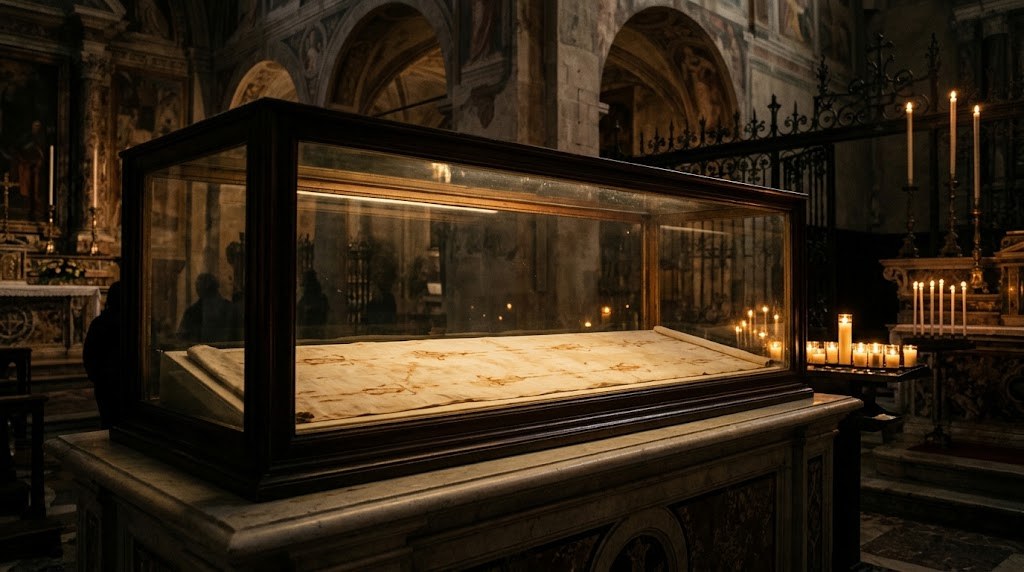
Inside a climate controlled case in Turin Cathedral lies a long strip of old linen. On it is the faint, ghostly image of a man who appears to have been crucified. For centuries some have believed it is the burial cloth of Jesus. Others are sure it was made in the Middle Ages. The Shroud of Turin may be the most scientifically studied object in the world, and it still divides experts.
Quick facts
| Size | About 4.4 m long and 1.1 m wide |
| Material | Linen woven in a herringbone pattern |
| First clear record | Lirey, France, in the 1350s |
| Home since 1578 | Turin, Italy |
| 1988 carbon date | AD 1260 to 1390 |
| Church position | An image to be venerated, with no official ruling on authenticity |
Where the shroud came from
The shroud enters the written record in the 1350s, when it was shown to pilgrims in a small church at Lirey in France. A local bishop wrote around 1389 that an artist had confessed to painting it, though that document has been debated ever since. The cloth later passed to the House of Savoy, survived a fire in 1532 that left burn marks and patches still visible today, and was moved to Turin in 1578.
The photograph that changed everything
In 1898 an Italian lawyer and amateur photographer, Secondo Pia, took the first photograph of the shroud. When he developed the glass plate he was stunned. The negative showed a far clearer, lifelike face than the cloth itself. In other words, the image on the shroud behaves like a photographic negative. That discovery turned a religious relic into a scientific puzzle.
The 1978 investigation
In 1978 a team of American scientists known as STURP spent five days examining the cloth with X rays, ultraviolet light and microscopes. They reported that the image sits only on the very top fibres of the linen, that they found no clear sign of paint pigment forming the image, and that the reddish stains tested positive for features of blood. They could not explain how the image was made.
The 1988 carbon dating
In 1988 small samples were cut from one corner and sent to three laboratories in Oxford, Zurich and Arizona. All three dated the linen to between AD 1260 and 1390, which fits neatly with its first appearance in France. For many scientists that settled the question.
Supporters of authenticity argue that the sample came from a repaired area, or that smoke from the 1532 fire and centuries of handling skewed the result. Later statistical reviews of the raw data have pointed to some inconsistencies between the samples, but no new full radiocarbon test has been allowed.
Could a medieval artist have made it?
This is the heart of the debate. Researchers have produced shroud like images using heated metal reliefs, chemical pastes and early camera obscura ideas, yet no one has fully matched every feature of the original, including the negative quality and the depth information hidden in the image. Sceptics reply that not knowing exactly how a medieval artist worked does not make the object ancient.
Where the debate stands
The Catholic Church does not claim the shroud is authentic. Popes have called it an icon that invites reflection, whatever its origin. The cloth is shown to the public only rarely, during special exhibitions. Until scientists are allowed new samples, the most studied cloth on Earth will keep its secrets.
Frequently asked questions
Is the Shroud of Turin real?
The cloth is real. Whether it wrapped the body of Jesus is the open question. The 1988 carbon dating places it in the Middle Ages, which most scientists accept.
Can you see the Shroud of Turin?
Only during public exhibitions announced by the Archdiocese of Turin. A replica is on display most of the time.
Why does the image look like a negative?
The light and dark areas are reversed, so a photograph's negative reveals a natural looking face. How this came about is still unexplained.
Keep reading
Sources
- Damon et al., "Radiocarbon dating of the Shroud of Turin", Nature, 1989
- Shroud of Turin Research Project (STURP) final report, 1981
- Archdiocese of Turin, official shroud information