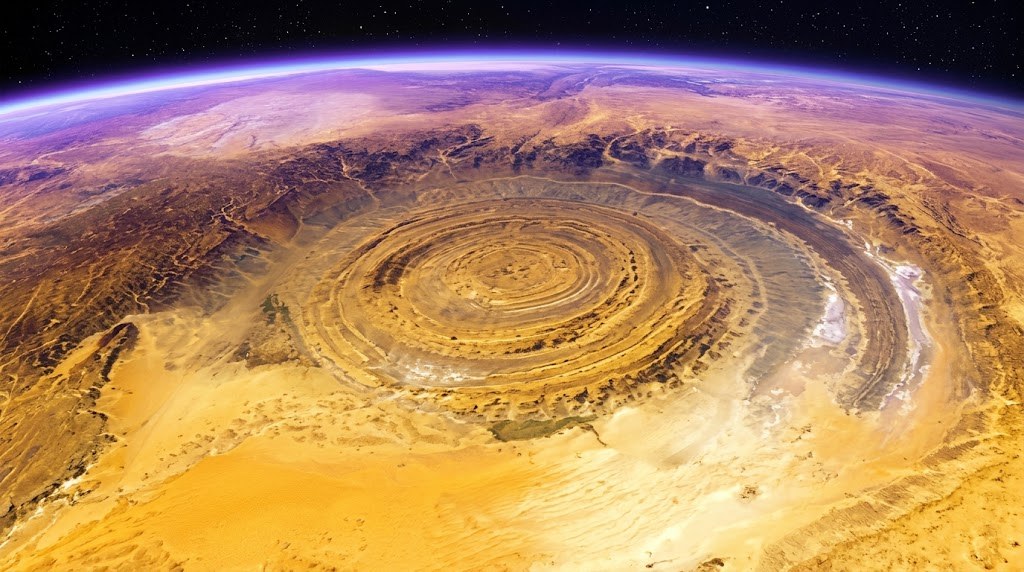
In the western Sahara, in the African country of Mauritania, there is a vast bullseye of rock rings carved into the desert. It is about 40 kilometres across, so large that it is hard to notice from the ground. From space it looks like a giant eye staring up at the sky. This is the Richat Structure, better known as the Eye of the Sahara.
Quick facts
| Location | Adrar Plateau, near Ouadane, Mauritania |
| Diameter | About 40 km |
| What it is | An eroded geological dome |
| Formed | Began over 100 million years ago |
| Famous because | Astronauts use it as a landmark from orbit |
A landmark for astronauts
The structure became widely known in the 1960s when astronauts on early US space missions photographed it. Because so much of the Sahara looks the same from orbit, the clear rings make an easy reference point, and it has been photographed from the International Space Station many times.
Not a crater after all
Its round shape first led scientists to suspect a meteorite impact. But field studies found none of the signs of an impact, such as shocked quartz or melted rock. The rock layers are also flat or gently curved, not smashed and thrown out as they would be in a crater.
How it really formed
Geologists now explain the Eye as a dome. Around the time the supercontinent Pangaea was breaking apart and the Atlantic Ocean was opening, molten rock pushed up from below and bent the overlying rock layers upwards into a large blister. Over tens of millions of years, wind and water wore the top of the dome away.
The layers are made of different rocks, some hard, such as quartzite, and some softer. Erosion removed the soft rock faster, leaving the hard layers standing as rings of ridges with valleys in between. The result is a natural cross section through the dome, a bit like slicing the top off an onion.
The Atlantis theory
Online videos sometimes claim that the Eye of the Sahara is the lost city of Atlantis, pointing to its circular rings, which loosely echo Plato's description of a city of concentric rings of land and water. Geologists and archaeologists reject this. The rings are natural rock formations millions of years old, and no remains of a large ancient city have been found there. For the real story of Plato's tale, see our guide to where Atlantis might be.
Can you visit?
Yes, though it is remote. Visitors usually travel from the town of Ouadane, a UNESCO listed old trading town, by four wheel drive. On the ground the rings are subtle, so a hot air balloon or small plane gives a much better view. Check current travel advice before planning a trip.
Frequently asked questions
Is the Eye of the Sahara a meteor crater?
No. It is an eroded dome of uplifted rock layers.
How big is the Eye of the Sahara?
About 40 km in diameter.
Is the Eye of the Sahara Atlantis?
No. That is a popular internet theory without scientific support.
Keep reading
Sources
- NASA Earth Observatory, Richat Structure
- Matton et al., "Resolving the Richat enigma: Doming and hydrothermal karstification above an alkaline complex", Geology, 2005