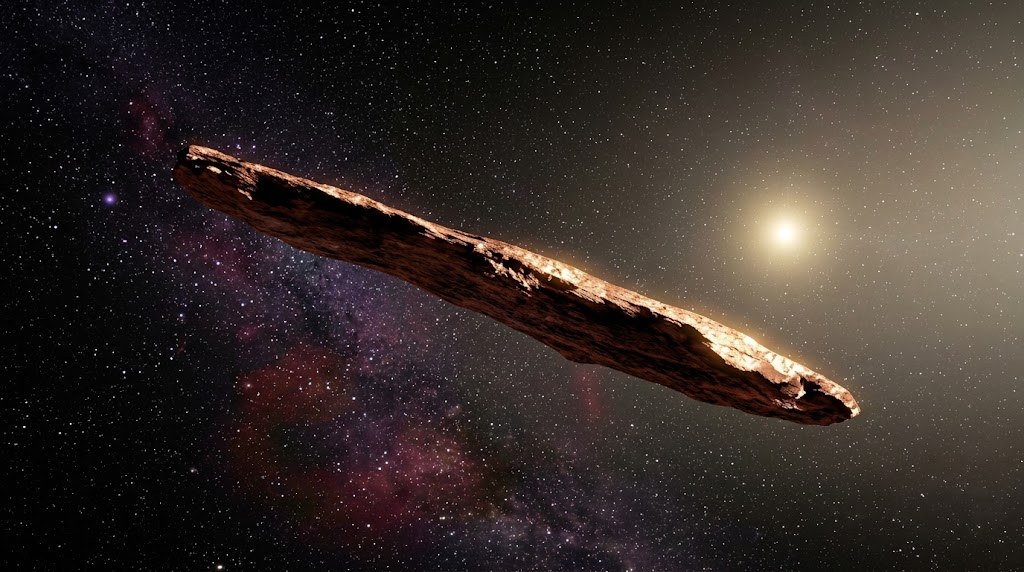
On 19 October 2017, astronomer Robert Weryk spotted a faint, fast moving object in images from the Pan STARRS telescope in Hawaii. Its path showed it was not bound to the Sun at all. It had come from interstellar space. ʻOumuamua was the first object ever confirmed to visit our solar system from another star, and it turned out to be very strange.
Quick facts
| Discovered | 19 October 2017 |
| Telescope | Pan STARRS1, Haleakalā, Hawaii |
| Official name | 1I/2017 U1 |
| Name meaning | Hawaiian for a scout or messenger from afar arriving first |
| Estimated size | Roughly 100 to 400 m long |
| Colour | Reddish |
Why it was so unusual
Its shape
ʻOumuamua's brightness changed dramatically as it tumbled, by a factor of about ten. That implies an extreme shape, either a long thin cigar or a flat pancake, far more stretched than any comet or asteroid seen in our solar system.
No tail
Comets release gas and dust as they warm near the Sun, forming a fuzzy coma and tail. Telescopes, including the Spitzer Space Telescope, saw no gas or dust at all from ʻOumuamua.
An unexplained push
In 2018 a team led by Marco Micheli reported in the journal Nature that ʻOumuamua was speeding up slightly as it moved away from the Sun, more than gravity alone could explain. For comets, that kind of push comes from gas jets. But no gas was seen.
The alien light sail idea
Harvard astronomer Avi Loeb suggested that the push could be explained if ʻOumuamua were extremely thin and flat, like a solar sail pushed by sunlight, possibly a piece of alien technology. The idea made headlines worldwide. Most astronomers disagreed, arguing that natural explanations should be ruled out first and that ʻOumuamua's other properties looked like those of a natural body.
Natural explanations
Several natural ideas have been proposed:
- Hydrogen release. In 2023 Jennifer Bergner and Darryl Seligman published research in Nature suggesting ʻOumuamua was an icy body whose ice had trapped hydrogen. As the Sun warmed it, the hydrogen escaped, giving a small push without a visible tail.
- Nitrogen ice. Another team proposed it was a fragment of nitrogen ice chipped off a Pluto like world in another solar system.
- A fluffy aggregate. Others suggested a very porous, low density object pushed by sunlight.
More visitors since
ʻOumuamua is now far out of reach, heading out of the solar system. But it is no longer alone. In 2019 astronomers found 2I/Borisov, a clearly comet like interstellar object, and in 2025 they discovered 3I/ATLAS. New telescopes such as the Vera C. Rubin Observatory are expected to find many more, which should help explain what ʻOumuamua really was.
Frequently asked questions
Was ʻOumuamua an alien spacecraft?
There is no evidence for that. Most scientists favour a natural icy body.
Where did ʻOumuamua come from?
From interstellar space. It approached from the direction of the constellation Lyra, but its original star system is unknown.
Can we still see ʻOumuamua?
No. It faded beyond the reach of telescopes in early 2018.
Keep reading
Sources
- Meech et al., "A brief visit from a red and extremely elongated interstellar asteroid", Nature, 2017
- Micheli et al., "Non gravitational acceleration in the trajectory of 1I/2017 U1", Nature, 2018
- Bergner and Seligman, Nature, 2023