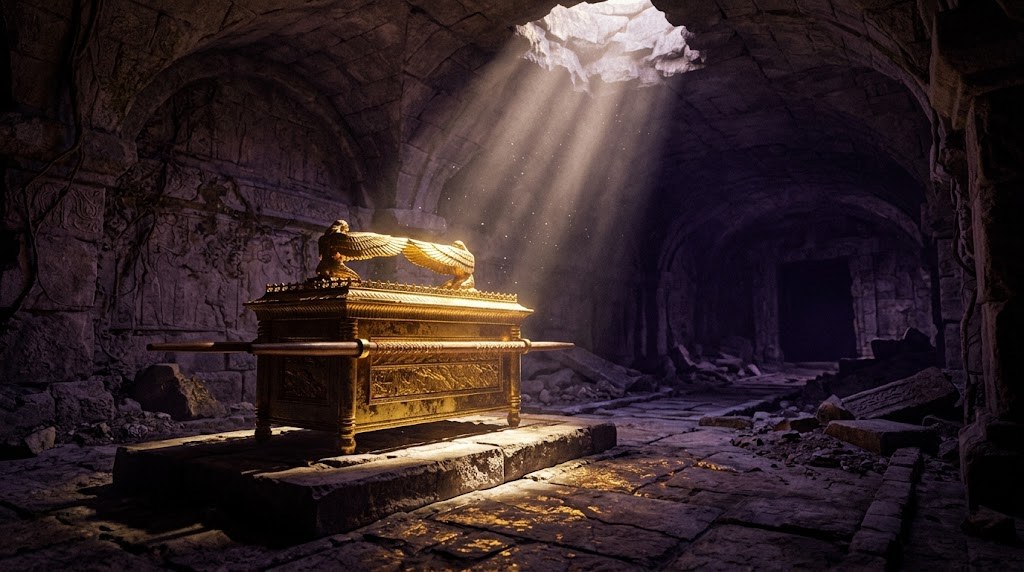
The Ark of the Covenant was the holiest object of ancient Israel. According to the Hebrew Bible it held the stone tablets of the Ten Commandments and was kept in the innermost room of the Temple in Jerusalem. Then, at some point, it simply drops out of the record. Its fate is one of the great lost treasure stories of all time.
Quick facts
| What it was | A sacred chest described in the Book of Exodus |
| Materials | Acacia wood covered in gold, with a gold lid |
| Size | 2.5 by 1.5 by 1.5 cubits, roughly 1.1 m by 0.7 m by 0.7 m |
| Contents | The tablets of the law, by tradition also Aaron's rod and a jar of manna |
| Last home | The Holy of Holies in Solomon's Temple, Jerusalem |
What the Bible describes
Exodus gives precise instructions for the Ark: a wooden chest overlaid with gold inside and out, carried on poles slid through gold rings, with a lid called the mercy seat topped by two golden cherubim facing each other. The Israelites carried it through the wilderness, into battle and across the Jordan. Later, King Solomon placed it in the Holy of Holies of the First Temple.
When did it disappear?
The Ark is never clearly mentioned again after the reign of King Josiah in the 600s BC. In 587 or 586 BC the Babylonian army destroyed Solomon's Temple. The lists of treasures they carried away do not name the Ark, and when the Second Temple was built decades later, its Holy of Holies was described as empty.
Theory 1: taken or destroyed by Babylon
The most straightforward explanation is that the Ark was seized during the Babylonian conquest and melted down for its gold, like many temple treasures. A later Jewish text, 2 Esdras, even says it was taken. Critics note that such an important object should have been listed among the spoils.
Theory 2: hidden before the invasion
Another tradition says the Ark was hidden to protect it. The Second Book of Maccabees claims the prophet Jeremiah sealed it in a cave on Mount Nebo. Other Jewish traditions place it in a secret chamber beneath the Temple Mount in Jerusalem, a site where excavation is impossible for religious and political reasons.
Theory 3: Ethiopia
The Ethiopian Orthodox Church holds that the Ark is kept in a chapel of the Church of Our Lady Mary of Zion in Aksum. According to the medieval Ethiopian epic Kebra Nagast, it was brought there by Menelik, the son of King Solomon and the Queen of Sheba. Only one guardian monk may see it, so the claim cannot be tested. Every Ethiopian Orthodox church keeps a replica of the tablets, called a tabot.
Theory 4: carried off to Egypt
The Bible records that the Egyptian pharaoh Shishak raided Jerusalem around 925 BC and took the treasures of the Temple. Some suggest the Ark was among them, an idea famously borrowed by the 1981 film Raiders of the Lost Ark.
Will it ever be found?
No archaeological evidence of the Ark has ever been found, and some historians question whether it existed exactly as described. Yet its pull on the imagination has never faded. As long as Aksum keeps its secret and the Temple Mount stays closed to digging, the mystery will remain.
Frequently asked questions
Has the Ark of the Covenant been found?
No. There is no verified discovery, despite many claims.
What was inside the Ark?
According to the Bible, the two stone tablets of the Ten Commandments. Later tradition adds Aaron's rod and a jar of manna.
Does Ethiopia have the Ark?
The Ethiopian Orthodox Church says so, but no outsider has been allowed to see it.
Keep reading
- The unopened tomb of Qin Shi Huang
- Ancient inventions ahead of their time
- The oldest city in the world
Sources
- Hebrew Bible: Exodus 25 and 37, 1 Kings 8 and 14, 2 Kings 25
- 2 Maccabees 2
- Kebra Nagast, Ethiopian national epic